DISCUSSION
Stretching
A lot of people view stretching as the goal, but really, stretching is an activity. You can have different goals, and those goals can be accomplished through stretching. Examples are:
- Therapeutic stretches — After an injury, a physiotherapist may prescribe specific stretches to release certain muscle tightness.
- Maintenance stretches — During a holiday, you don’t want to spend too much time stretching, but you do want to at least maintain the flexibility you already have.
- Protective stretches — Before an active game, you want your body to be able to move through the range of motion required for your sport, helping to avoid injuries. You are not stretching to any extreme positions, but simply getting the body ready to perform through its required range.
- Development stretches — The intention is to go beyond the flexibility that you normally have. You will be exploring new territory and a range beyond what you can normally do. This is where the phrase “Explore the last inch” applies.
We went through the details of the following stretches:
- Neck and shoulders
- Lower back
- Legs and hips
- Hamstrings
- Groin
- Hip flexors
CONCEPTS and PHILOSOPHIES
Magic of Yes and ..
We talked a lot about the advantages of absorbing, redirecting, and going along with the forces of the aggressor. We also talked about the need to “technically relax and calm” ourselves in a confrontation. I know that, at this point, it is not natural for you because, your whole life, you have been taught otherwise. Therefore, we experimented through wrist-lock escapes, the differences between different types of responses when you push me, and many more exercises.
Saying “YES and …” starts to blend the desirable state of response you learned from “self-defense” into your normal daily life. Think of how many times you get into an argument (fighting) with your family—kids, spouse, parents, in-laws, etc.—because you are simply using your gut response rather than a goal-oriented, strategic response.
Do give it a try. The trigger is: every time you feel irked, breathe, and then think of a better response. Once you manage to at least pause and think, you will notice that you are on the path to training this seemingly impossible reversal of a default reaction. The classes and physical drills with partners will also help blend what you learn into becoming part of who you are.
Tagging
We use “tagging” to mean creating a moment where the opponent is so distracted or disrupted that he cannot respond effectively.
A term more familiar to most people is “feint” or “trick.” I think these are too specific. They are only a small subset of the many ways you can create a freeze/misdirection effect.
An effective tag can create an opening that was not there before.
Examples include:
- Disturbing his balance
- A sudden loud yell
- Blocking his vision with your palm
- And many more
The important thing is not the particular tag. It is the effect it creates.
Importance of Play Mode
It is interesting how quickly your mental state can change—as if there is a switch in your brain.
Learn to harness that switch and you can become much more effective in dealing with people and situations.
As an experiment, I tried this with one of you using the game “slap hand.” She was surprised by the result. She described it as feeling like a shock going through her brain: suddenly alert, with work mode completely switched off.
This can also be useful in everyday life.
Getting your parents or kids to work out can be one of the hardest sells—even when you know it is good for them. Instead of talking or preaching to them, try playing with them.
(NO, I don’t mean slapping them, even though there may be some rare situations where that thought crosses your mind!)
You may get much better acceptance—and you may even have fun yourself.
You can also use play mode for yourself. Track your progress and celebrate small accomplishments. Think of the little stars kids get when they accomplish something.
It works for kids. It also works for almost everyone. You just need to be smart about it.
Focus on your goals not the noises
When confronted with a push or a punch, our attention naturally goes to the attack.
- How do I block it?
- How do I stop it?
- Can I react fast enough?
This often causes us to tense up because blocking requires precision, speed, and power. Worse, we may forget that we have another tool to stop the attack: our counter.
A better way is to look at his vulnerabilities that you can target. That usually means everything EXCEPT his attack. This opens up endless options.
If you treat the attack as simply “noise,” reduce the effect of his attack and tune it out, and focus on how you can hurt him instead, your confidence will increase dramatically.
This same strategy can be applied in your daily life as well: instead of focusing on the irritation a problem creates, focus on getting to the end goal.
SKILLS & SCENARIOS
Wrist Lock
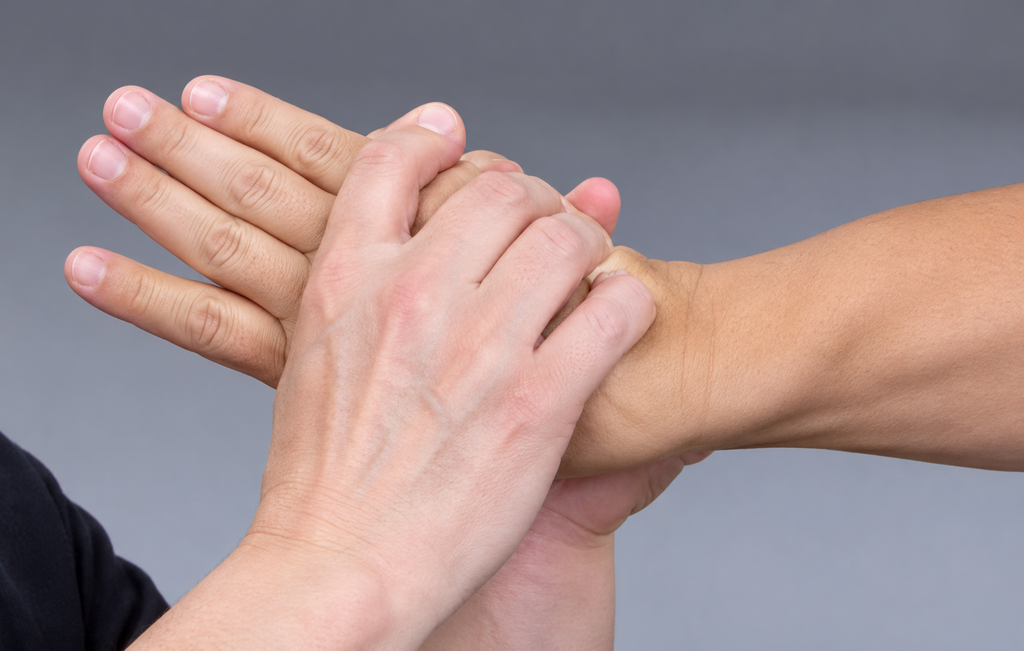
If you go onto YouTube, you can easily find many examples of wrist locks. However, quite a few are questionable because they are relatively easy to escape from.
Individual differences in flexibility, combined with differences in how the mechanics are applied, can greatly change the time and effort required to secure the lock. Some of these examples may therefore be dangerous, or simply unusable, if the attacker is stronger than you.
For us, it is important to separate two things:
- Entry — How do you get your opponent’s hand into the position required for the lock?
- Execution — Why does the lock work anatomically, and how do you efficiently and effectively secure it?
You can have many different entries into the same execution.
For many people, all these combinations are classified as different techniques. For us, they are simply different entries into the same specific lock.
In class, we experimented with three different entries:
- Hand on shoulder — same side
- Hand on elbow — same side
- Wrist grab — same side
The goal is not to memorize three techniques. It is to understand the entry → execution relationship.
Cannot Be Lifted Individual
We experimented with two men trying to lift a female who was much lighter than either of them.
When she tightened up, it was relatively easy for them to overcome her body weight and lift her.
However, when she was instructed to relax and gently wiggle her shoulders and body, she suddenly felt much heavier and became almost impossible to lift.
The wiggling serves two purposes:
- Absorb the lifting force — rather than resisting the force directly.
- Prevent a firm grip — the constant movement makes it difficult for the lifters to establish a stable grip from which they can generate power.
This is a good example of why so many of our defensive skills are based on two things:
Relaxation + understanding mechanics.
This is counterintuitive and certainly not our default response. That is why it requires practice.
The goal is not simply to learn a technique. It is to train your body to respond differently when force is applied.
SIDE NOTES
I hope you will try to read the notes from Bonsor. Ask questions if you are curious.