CONCEPTS & STRATEGIES
Striking Kinetic Chain
Do remember that there is a huge difference between your ability to move fast to move fast vs the willingness to move fast.
The path through which your striking energy travels is referred to as the power chain. If that path is relatively straight, the strike will be relatively fast and therefore powerful. If however, there are leaks of this power chain, than the energy is severely reduced. Just image the difficulty you encounter by using one end of a chopstick to push the end of another chopstick, you may push it a inch and suddenly, if it bends at the connection between the chopsticks, the chopstick being push will no longer be moving forward. This “breaking of connection” is what we call “leaks” of the power chain.
If you punch a straight punch and you pop up your shoulder, or your elbow flare out, then the power flow will be severely affected.
The “LRT” Self Defense Principles
- Listen / Look – responsiveness, alertness and sensitivity to changes and irregularities. For example, a good driver is always aware of not only the road ahead but cars and pedestrians on the side and behind. You can read a car’s body language to anticipate trouble.
- Resources – training physical and mental, managing your own resources and to exhaust opponent’s resources, be able to tap into environmental / situational resources.
- Target – avoid being a target, move the target, change your opponent’s target through rotation of the body, breathing out to absorb the hit or move out of the way so he cannot reach.
Center Line Theory and the “Eight Inch Rule”
If we view the human body as a rectangular box, your defense need to only protect anything that aims towards the box. Anything going outside that rectangle is not relevant. This is a very important principle for the following reasons:
- If you divide the rectangle on the center line, than there are 2 halves. If you further draw a line at around the belly button, now, your entire body is divided into 4 quadrants. If we assign the right hand to guard the right quadrant, the left for the left quadrant and right leg for the right lower half of your body and left leg for the left, then each defender need not travel too far. If however, you use the left hand to go mind things happening on the right side, it has to travel quite a distance and will open up the left side which it should be guarding. If each stick to their defensive zones, the defense should not have to travel more than eight inches.
Redirection
Develop the ability to alter your opponent’s intent or direction of force so the hits cannot reach their intended target. Hard blocking is the least efficient option and therefore always at the bottom of the list of options.
One method demonstrated in class is changing the angle of your body relative to the attack through stepping or rotation. This will cause their strike to miss or fail to land square and therefore greatly discounted. This earns you a momentary opportunity to turn the tide.
Use of Elbow and Shoulder
Beyond using fists to punch or feet to kick, the elbows, shoulders, and head are all effective striking tools when used correctly:
- The Shoulder: A powerful, blunt-force weapon ideal for close-range displacement.
- The Elbow Tip: Sharp, heavy, and devastating, with very low risk of injuring yourself.
- The Hands: Excellent for reach, though many fighters fracture their hands hitting a hard target like the skull.
Every tool has its pros and cons; you should be comfortable and familiar with all of them.
Arriving at the fight or flight decision
Do not wait until you are in the middle of a confrontation to consider your options. You know how long it can take to decide where to go for dinner—except in a real self-defense scenario, you do not have that kind of time.
Establish your “red lines” well ahead of time. Once a line is crossed and you make your decision, do not hesitate or second-guess yourself. Assuming you are the underdog, opportunities to act do not come easily. If you commit to fighting, you must commit fully with intense determination. Your mindset must shift to focus on “how much impact I can inflict to stop the threat,” not “how much it might hurt if I get hit.”
Structure of Guard
Arms & Elbows: Keep your elbows resting near your ribs with your forearms facing the opponent. Extend forward slightly to maintain a protective barrier without lifting your elbows. Check to ensure your forearms are not pointing up toward the ceiling, as this makes your guard easy to jam.
Head & Core: Tuck your chin to protect your throat, keeping your forehead slightly ahead of your nose. Round your upper back slightly to maintain structural integrity.
Hand Position: Keep both hands balanced at roughly chin height. Don’t hold a tight fist because it will slow you down. Squeeze your fist tightly only when the strike is landing.
Crucial Rule: Remember that no guard or posture is completely “safe” or invulnerable. A good posture minimizes risk, but it is far more important to keep your structure dynamic and transition smoothly as the situation demands.
SCENARIOS
Jamming vs slide-and-redirect
Jamming: Jamming a punch is still better than blocking it sideways. Jamming involves crashing forward into the incoming attack before it can fully materialize. If your opponent fakes the strike, you are already moving in. The disadvantage is that you tend to become too tense, and if the opponent is bigger and heavier, you risk getting bounced off.
Slide-and-Redirect: With a slide-and-redirect, you do not crash against the incoming force. You simply move whatever target they are aiming at and redirect the attack slightly off its original course. Because you slide your strike along their arm, any blow that connects will still be reasonably powerful.
Pushing vs displacement
Standard Pushing: Standard pushing involves extending your arms outward against an opponent. If used in a real-world scenario, it can still inflict serious harm—such as pushing someone into traffic or causing them to fall and hit their head on the pavement.
Our Method (Displacement): Our version of pushing does not rely on arm extension. Instead, you lock your joints and deliver your entire body weight by driving your legs directly into the ground. So your opponent is effectively displaced with full power.
Linking the basic wrist grab escapes to more aggressive responses
We began by working on basic wrist escapes when we first started. However, these techniques are not quite ready for real-world application if you still hesitate, look, or pause to think before reacting. Self-defense movements must be fluid, and your reaction must be nearly instantaneous. Your entire body must coordinate seamlessly, or you will end up telegraphing your intent. All these require lots of repetitions, not “just knowing” what is possible.
While we start with peaceful de-escalation, these escapes your learned can be paired with aggressive follow-ups—such as an elbow strike, a shoulder throw/body slam, or a wrist lock. You need to practice these transitions until they flow smoothly with no gaps.
SIDE NOTES
This is the last class for the season. The Bonsor folks might wonder why the session felt short. We did 1.5-hour classes from 6:00 to 7:30 p.m., for a total of 9 hours (compared to Bonsor’s twelve 1-hour classes). The pace is quite different! How I wish I could compress 60 years of training into something much shorter.
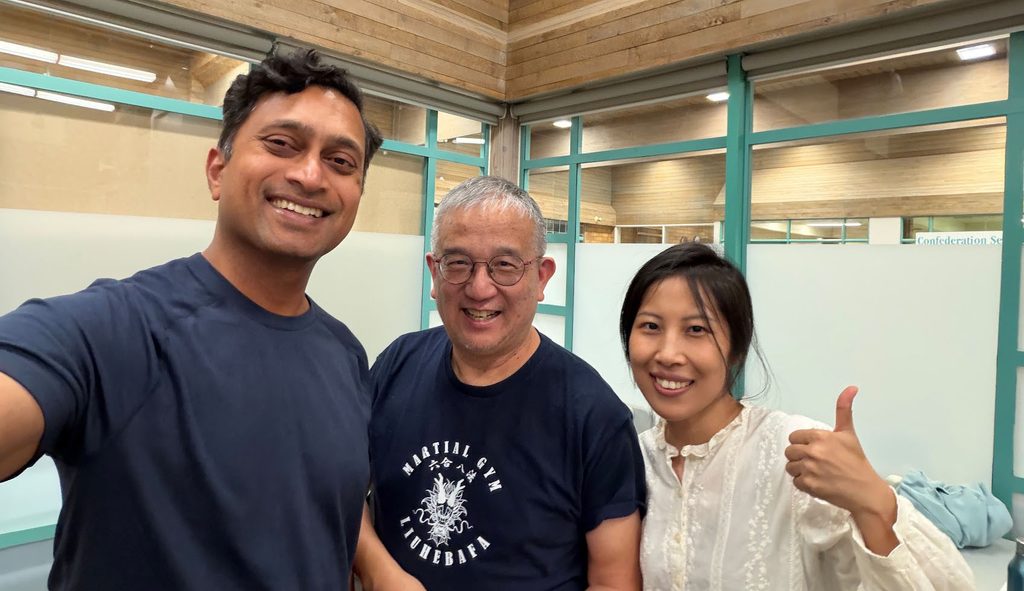
While we ended with just two of you, I thank you both for your unwavering support—it has been a blast. Thursdays have always been a fun day of teaching for me. I start the morning with self-defense at Bonsor, move on to Functional Fitness at Christine Saint Clair, and finish with self-defense in the evening at Confederation Park. Kung Fu has always been kind to me, and through it, I have met so many wonderful people. Between my students and other aspects of my life—such as my career in the tech industry, involvement in rhythmic gymnastics, teaching everyone from 4-year-olds to seniors in their 90s and those with learning disabilities, and training coaches—this journey has been deeply fulfilling. Ultimately, I am still learning and improving through everyday experiences, and I hope the same for you.
Since there were only two participants tonight, we got to hit some kicking pads so you could feel what it is like on the receiving end. Both of you even asked me to punch you on the arm to get a feel for an unprotected, gentle tapping punch—you have earned my respect!
We haven’t scheduled any classes for the winter season because it gets dark so early by 6:00 p.m., and we will inevitably encounter snow and icy nights. Classes will resume in April when the days grow longer.
I hope you both enjoyed the class and took something meaningful from it, even if you never intend to be in a fight. Through this journey, I hope you managed to catch a glimpse of the incredible potential we are given at birth—the kind that never came with a full owner’s manual.