Force Generation from the Core, The arms act as connectors, transmitting force generated by the core and lower body through contact. Tensing the arms or trying to generate force with them in isolation weakens its delivery. Maintain arm alignment and contact so that core-driven force flows through without telegraphing your intention.
Step-and-Sink Movement Mechanics: The foundational diagonal “step-and-sink” pattern is inspired by skating. Remain upright, bend the knees while letting your body weight shift diagonally downward, like a snow shovel moving through snow. Integrate the sinking and driving actions into one relaxed movement to prevent the bounce-back caused by action and reaction.
Consequential Movement: In the wrist-grab escapes, you have learned not to initiate movement from the point of contact. Instead, movement at the contact point is generated indirectly by moving other body parts that are not controlled by the specific grip. Fighting locally at the point of contact is the wrong approach when your goal is to escape without directly confronting the force of the grip.
Defense mindset: In self-defense, if you need to fight, be prepared to take some hits. Don’t expect to win without paying a price yourself. Your objective is to survive, not to perform like an actor in the movies. You must maintain the initiative, recognize and capitalize on opportunities, and keep moving to generate power for your hits while avoiding hits.
SCENARIOS
Affect your opponent from a standup position
When we talk about self defense, we do not have a referee to get both of us in a stance to get ready. It can easily be a powerful shuffle on your chest while you are standing upright. You have to be able to response without ANY preparation. You will be flying backwards if you try to get ready by sitting into a stance. This is where the technique “STEP AND SINK” can be really useful.
Stepping-Into Pressure zone (Self-Defense Application): Override the instinct to step backward. Instead, step forward or sideways into the aggressor while rounding and driving from the core. Whenever you lift a leg to step in any direction, you risk being thrown off balance because the transition to standing on one leg is a vulnerable position. Keeping your legs spread about shoulder-width apart provides greater stability. Learn to generate power directly from this stable, standing position without relying on stepping.
EXERCISES
Static Push Alignment, Muscle Efficiency, and Joint Locking: In isometric pushes against a fixed barrier, do not lean, you should maintain a relatively vertical but slightly rounded torso, bent rear leg with knee pointing slightly out, seated hips, and lock skeletal joints so that they do not leak any power delivered. Eliminate wind-up and visible shifts; relax unnecessary tension (e.g., excessive abs/glutes) to prevent leverage against yourself. enable Defensive redirection should not require a lot of movement and sometimes even with just the fingers.
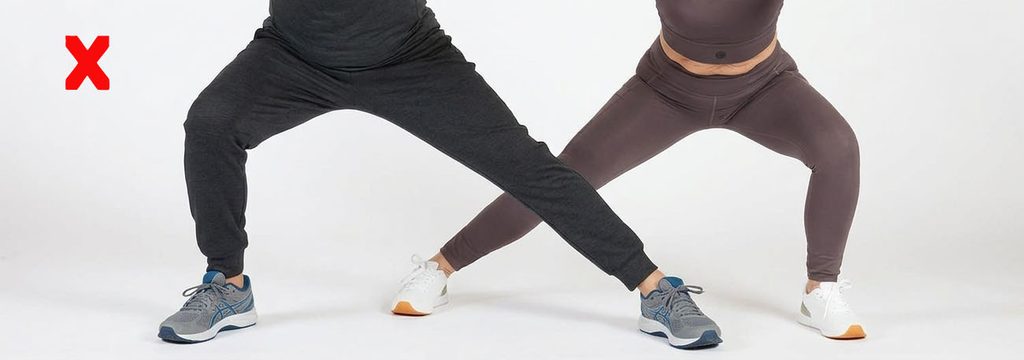
Knee Joint Safety in Lunges: I do not recommend the side lunge stretch—especially for seniors—due to two main risks:
- Knee Joint Grinding: The lateral movement creates a grinding action on the bent knee joint.
- Medial Ligament Strain: The straight leg distributes stretch forces along its entire length, including the ligaments on the inner knee. Because of the long lever arm, the resulting torque is relatively high.
There are safer, more effective ways to stretch the inner groin without exposing the knee to these risks.
Squats
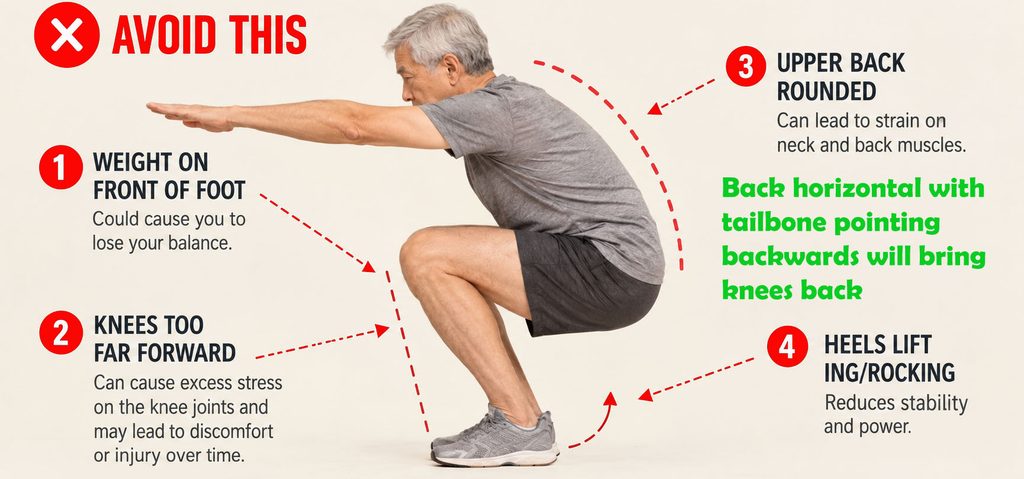
Squats are great to train your thigh muscles. However, squats not done properly will bring undue stress to your knees. Flat back with tailbone pointing backwards will bring relieve instantly.
Ground Conditioning & Backward Crawl Mechanics: Functional floor drills (such as the fishtail and backward crawl) build arm, shoulder, and core strength. Keep your elbows slightly bent and avoid lumbar overextension or a “butt out” posture. Emphasize coordination, controlled deceleration, and muscle awareness—engaging the core and shoulders rather than stressing the lower back.
Note to Students:
“Are you sure you have thoroughly reviewed the exercise list from last week, understand how to perform each move, and know its intended purpose? If not, please ask about it during our upcoming class.”