SSD – Class notes 2025-12-04

DISCUSSION

Various Steps Explained

Stutter steps – this meaning repeating the front leg’s action of stepping as front. It is often used when you want to add more body weight to your push or strike at close range without changing the lead foot.

Gallop steps – Gallop steps conserve energy and can be performed high (with legs relatively straight) or low (close to a low stance). Their main advantage is that they allow you to cover long distances without the exposure that comes from switching your lead leg.

Angling tuck steps – this step is to most often used in conjunction with the upper body’s avoidance action of a hit to the head when your upper body instinctively ducks or moves off the line of fire. The leg moves in the same direction to amplify that evasive action. The movement is fast because it is a tuck powered by your core plus gravity. Since your support leg leaves the ground, gravity helps pull you in the direction your body is already moving.

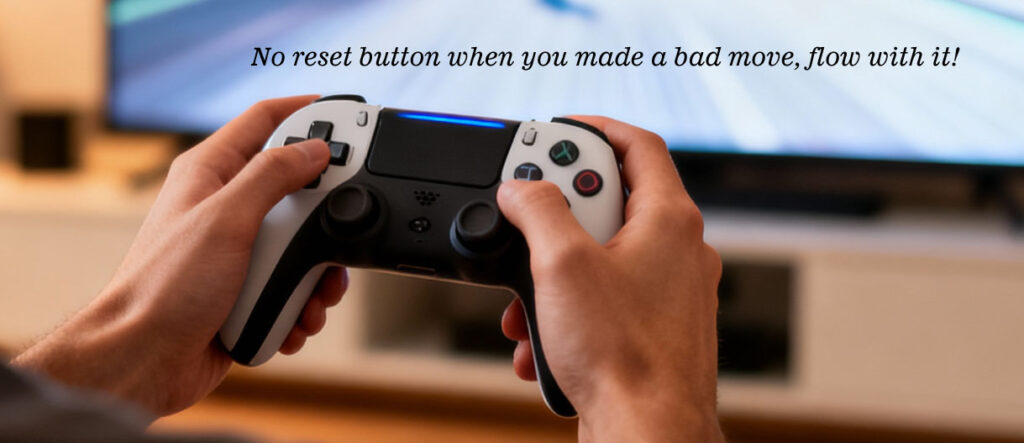
Go with the flow, do NOT RESET

Striving for perfection is a good mindset, but it can also become a handicap. Imagine a writer trying to create the perfect novel—very often they freeze, second-guess themselves, and tear up draft after draft. Or imagine trying to teach a baby to walk perfectly on the very first day; it would be frustrating for both you and the baby.
To succeed, you must stay focused on the end goal, not the bumps and struggles along the way. In a fight—or in any challenge—you must be ready to take hits and keep going. Do not stop because of small setbacks or small successes. Continue until the job is done.

A better approach is to continuously get them to try continuously, keep trying and keep it safe.

Train to Be a Warrior

  • Heart (Passion) – You must care about something: yourself, your quality of life, your principles, or the people who care about you. That passion drives you to do whatever it takes to protect what matters.
  • Accountability – Wishing is not enough. You must take ownership of the work required to make things happen. You do not blame others; you focus on what you can do to improve the odds. You avoid procrastination and keep yourself ready—even if the opportunity appears for only a split second.
  • Toughness – Training is sometimes painful. Change is difficult. Survival is hard. Face challenges now so that you are ready to be tough when it truly counts.

SCENARIOS

Push is a very useful maneuver when you don’t really want to injure the opposing party. Care must be taken that even a push without any intention-to-harm might accidental cause significant damage. For example, if on the street, the person falling hit the back of their head on concrete; or someone fell backward and landed on their tailbone.

Some common mistakes with this push partner drill:

  • Start pushing at maximum
  • Stand square facing your partner
  • Body not working as ONE
  • Arms over bent into an acute angle or too extended during the push

EXERCISES

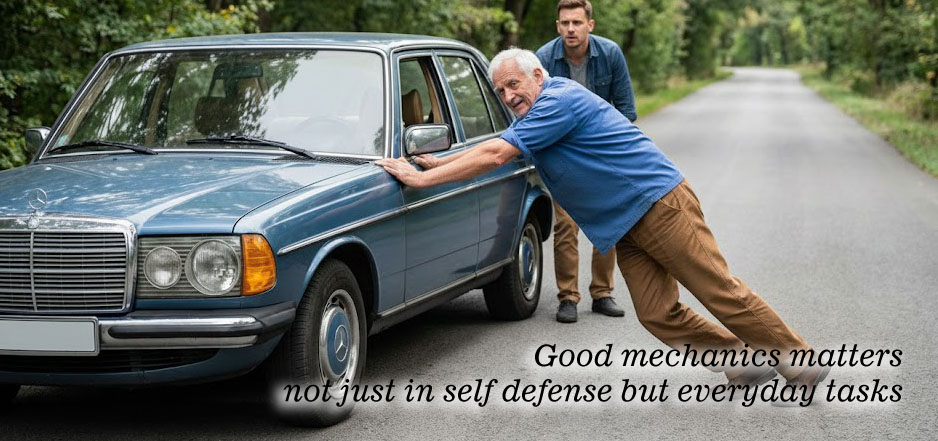
As we have seen many times, the right mindset can transform the mechanics and delivery of a movement. Apply this to the push exercise by focusing on maintaining the integrity of your whole body rather than extending the arm or creating unnecessary tension in your arms or abs.

While keeping the pressure constant, see if you can reduce the tension in your arms and body without decreasing the force you deliver. Do you notice that when you slightly relax your back into a gentle slouch, you can actually deliver more power without adding muscle tension?

Can you try to do the plank now and play with varying tensions on different parts of your body?
SSD – Class notes 2025-11-27

DISCUSSION

Pushing Mechanics

Leg position – the majority of people started the push with back leg straight. However, this may be good only if you are attempting in a defensive position where you feel you need to count on structure for support. However, if you want to generate enough pushing power to affect your opponent, straight leg takes away the possibility of pushing with leg muscles.

Legs should be bent at knee at about 90 degrees. The knee should not be facing the ground in almost a kneeing position. It should be facing between 30-45 degrees of the frontal line so that you foot can be placed comfortably.

Arm position – The elbows should be relaxed and pointing downward. Keep the shoulders relaxed and settled into your upper-body frame. Instead of actively trying to push with your arms, maintain this “relaxed shape” and imagine your body and arms as a single connected unit. The arms will transmit force naturally when the whole body moves.

Body position – It is tempting to lean your body into the push to add weight, but this creates several problems. If your opponent steps back while you are leaning in, you may lose balance and fall forward—unacceptable in a live exchange. Keep your torso relatively upright and relaxed (but not limp). You may round and sink the body slightly to help redirect force downward into your legs.

Avoid arching your lower back, as this often causes the abdominal muscles to tighten and makes your body rigid. A rigid structure becomes a lever your opponent can exploit. Instead, relax your back and lower back, allowing a gentle pelvic tilt so force from the ground to your legs and can pass smoothly through your body structure.

Placement of Center of Gravity

Physics tells us that if your center of gravity (CG) is positioned directly above the edge of your base of support, any movement beyond that point will cause the entire structure to collapse. While advanced practitioners may still maintain stability in such conditions, beginners should play it safe and keep their CG centered between both feet.

You can observe a similar principle in professional tennis: when waiting for a serve, players distribute their weight roughly 50/50 so they can move easily in either direction.

What is the best way to step forward?

We all hope there is just one type of stepping to master—wouldn’t that be nice? In reality, different situations call for different types of footwork. Here are a few examples that I will try to cover next class:

  • Gallops – used to quickly cover distance when you don’t yet have contact with your opponent.
  • Stutter steps – used to add body weight and momentum into your technique.
  • Switch steps – used to change the leading foot and potentially adjust your angle, either to evade or to add power to kicks.
  • Angling steps – to stay at same distance but at a different angle.
  • Heel-toe – again an angling maneuver where you step without stepping
  • Safe-your-bacon step – to be able to release your weighted leg. This is especially important for seniors to save yourself from tripping over uneven pavement, etc.
  • Step-through – bringing the back foot past the front foot, similar to walking. This becomes challenging when you are already feeling resistance from your opponent or when you need to deliver a fast, long-distance strike with a changed lead.

…and many more.

SCENARIOS

  • Try to push with different leg, arm and body positions and experience how it feels.
  • Try tighten up your body using chest and apps
  • Experiment with hands on partner’s shoulder versus hip
  • Try to push against partners with different heights and body built as compared to you.
  • Apply the knowledge about a strong stance versus a weak stance from previous classes.

EXERCISES

Practice push-the-wall – the wall will not move and so it is easy to detect if any part of your body leaks out the pushing force. Read the discussion on the top to focus in on what to focus on. Feel your body and see if you can deliver the same thrust without engaging your whole body.

Do try also the “extension” push where you extend your shoulder, chest and arms without moving your abs and lower body.

Plank – plank is a good exercise to strengthen your core. Do not allow your body to sag. You should have a slightly rounded back. Try to hold until you shake and then count eight more slow count.

SSD – Class notes 2025-11-20

DISCUSSION

Characteristics of a good defense technique

If you describe the purpose of blocking a punch simply as avoiding getting hit, that is valid—but it’s not enough. This mindset keeps you one beat behind and focuses your attention on the opponent’s punch rather than on the openings that they are giving you.

Our method focuses on the following principles:

  • Create something the opponent must respond to.
    Don’t just react; give them a problem to solve.
  • Move off the line of fire so you don’t absorb the full impact of the strike. Furthermore, they have to find you!
  • Affect the opponent physically and mentally so they must adjust—or get hit.
  • Be either fully out or fully in.
    Avoid the mid-range where the opponent has many striking options.
  • Limit the opponent’s choices as much as possible so the exchange is no longer a guessing game.
  • Use double-layered strategy whenever possible – for example, use structural support AND move the target AND breath out to absorb all at the same time rather than relying on a single method and hoping it always works.

Structural support

In general, the human body uses bones for structure and muscles for movement. Many people focus too heavily on muscle use and forget the power that comes from proper structural alignment.

Here are some of the benefits of using body structure:

  • Muscles consume energy, and you will fatigue over time.
  • Muscles require reaction time, which means they can be late.
  • Excess tension slows movement and can even cause opposing muscles to fight each other. For example, tensing both the biceps and triceps before punching makes a fast, strong strike impossible—though it may look good on a bodybuilding stage.

Don’t fall into the trap of thinking internal styles like Taichi do not use muscles. If you’re standing, you are using muscles. If you bend your knees, you are using thigh muscles. The key difference is the focus: not on muscle contraction, but on the task at hand.

Some people tense their shoulders and arms before striking. These “preparations” are telegraphs, signals that reveal your intention to your opponent.

As a senior, percentages are against you if someone cares to bully you. Don’t compete on his terms, learn to fight smart. Apply the laws of physics like leverage, shape, etc.

Muscles require commitment to generate power. A properly aligned structure can remain in place indefinitely and function automatically when needed, with no advance signal.

Structure is extremely strong when used as intended, but very weak when pushed beyond its limits. A toothpick can deliver a painful poke if you press its tip against your finger, yet it snaps easily when pressed from the side.

SCENARIOS

Defense against circular swings

“Stay out or in.”
Circular hooks or swings often have shorter reach than straight punches. When you are outside their reach, you are safe. When you are inside—past the distance they train their heavy bag—you enter a zone where they often feel they need “more room” to hit harder. That close range can be a safe zone if you know how to use it.

Point your elbow at the swinging arm.

If the opponent’s arm strikes your elbow perpendicularly, there is a good chance they will injure themselves badly.

Warning: The following video is gruesome but reflects real-world consequences.

Review and practice defense against six grips

  • Low, crossover, thumbs-up grip
  • Low crossover, palms down grip
  • Low, same-side, thumbs-up grip
  • High crossover grip
  • High same-side grip
  • Two-arms-low grip

EXERCISES

Some of you are still struggling with the “gallops.” Here are a few things to avoid:

  • Do NOT use the terms “front” and “back.”
    These refer to where you are looking, not the direction of movement. The key consideration is your direction of travel, so please use the terms “leading” and “trailing.”
  • Do NOT gallop with noticeable level changes on each step.
    This wastes energy and time—save that effort for when you truly need to sprint away. Keep your movement smooth and maintain a consistent height unless there is a specific purpose for changing levels.

Some of you also mentioned that there are many concepts to absorb. Reprogram your brain over time by reading the class notes, applying the principles by brainstorming examples where the theories are applicable. This mental training is just as important as the physical training.

SSD – Class notes 2025-11-13

DISCUSSION

I cannot…YET

I understand the challenge you felt while learning some of these skills. “Relax” can feel completely counterintuitive. It is hard—but it’s not impossible. It simply takes repetition. Remember: “You cannot … yet.”

I’ve included an old video of a pike that seems to learn from repeated failed attempts. Please watch it all the way to the end:

My takeaway is this: don’t give up, no matter how difficult something feels in the moment. You have a teacher (me) as a resource to support you. You have support from classmates that probably went through similar experiences. If you persevere, what feels hard today will eventually become easy.

Constraints

Water naturally takes the shape of its container and always flows to the lowest point—both well-known facts. But we also know water changes state under different temperatures. As steam, it rises; as liquid, it flows and adapts; as ice, it becomes rigid and even expands compared to its volume at room temperature.

The skills we learn in martial arts or self-defense also operate within certain parameters. For example, if space is limited, running away may no longer be an option. If an attacker is so tall that you cannot reach his nose, aiming for a nose-strike is not realistic. If you’re holding a thin bamboo stick, it won’t deliver much impact as a weapon. And if your arm is limp, you won’t have much leverage. While you must first practice techniques as they are taught, you should also test and adapt them under different conditions.

Constraints or limitations can be:

  • Self-related constraints
    You may have injured your ankle the day before. You might be lying down and unable to move backward or get up easily. You could be physically outsized by your opponent. Or you may have a child with you whom you must protect.
  • Opponent-related constraints
    Your opponent may have unusually long limbs and you may have a hard time reaching him. If it’s winter and he’s wearing a thick jacket, your punches may not cause enough damage. Or he may be strong, fast, muscular, and able to absorb hits more easily.
  • Environmental constraints
    You might be in an elevator with very limited space. You could be walking on an icy surface while wearing shoes with poor traction. Or you might be seated on a park bench, making movement more difficult.

Crowbar Principle — Leverage

When escaping someone’s grip, we often rely on the crowbar principle.

  • Relax and clear your mind.
    Tensing up prevents you from thinking clearly and usually disrupts the mechanics that would otherwise work in your favor.
  • Do not “lift the box.”
    Do not try to lift or overpower the opponent’s hold directly. Most likely, you are not the stronger one.
  • Establish a fixed pivot point that does not move.
    You may move other parts of your arm or body, but the pivot must remain stationary. A common mistake is accidentally pushing the pivot point itself—once it moves, you lose leverage.
  • Generate a power lever by extending the energy through your body – a “longer handle” amplifies the power you can generate without tensing up more.
  • Project energy through your arm and fingers. Do not leave your fingers bent or hold the hand in a fist. This creates a longer “crowbar tongue” for better leverage.

SCENARIOS
Defense Against a Straight Punch

“Wax on / wax off” demonstrated how seemingly simple or repetitive movements can become useful in self-defense, and it highlighted the value of training. However, from a technical standpoint, it is not our preferred method.

The “wax on / wax off” approach comes from a paradigm where you defend first and strike later. The focus is on blocking the attack and then looking for an opportunity to counter. This type of block has several drawbacks:

  • If you misread a fake punch, your hand will be drawn out to the side, leaving you exposed to follow-up strikes.
  • Because you react after the punch has started, you are already a beat behind. You must rely on speed and experience to intercept the punch in time. The extra, non-productive travel your hand must make to reach the punch is wasted time. As a senior, you cannot assume you will be faster than your attacker.
  • You cannot predict whether you can actually move the attacker’s arm once you make contact. You won’t know until you touch, and by then it may be too late to change your action.
  • A block that is not directed toward the attacker can actually fuel his aggression. By attempting to block, you may provoke him to prove he is stronger.

Defense Against a Swinging Punch

The most dangerous reaction is to panic, stiffen your body, and remain at arm’s-reach distance. At that range, punches, kicks, and tackles are all possible, and things happen so quickly that you are likely to get hit.

Staying out of reach is obviously safer—but going all the way in is often counterintuitive. Yet, if you close the distance until you are only inches away, a swinging punch may still hurt but is far less likely to knock you out. Most people cannot generate full power at extremely close range.

Characteristics of Our Preferred Defense Approach

  • The blocking hand does not travel sideways. Instead, it shoots directly over the attacker’s arm toward his face or eyes.
  • If the punch turns out to be a fake and the attacker retracts, your hand ends up right at his face, removing his initial advantage.
  • A hand near his face forces him to pull back or duck, obstructing his vision and reducing his ability to react to your next move.

Review of the grips

We reviewed the following grips, can you name to key-points for each? Remember to look back at the class notes in for the fall season session or even earlier. If you really can’t find the answer, do arrive early to class and ask:

  • Low, crossover, thumbs-up grip
  • Low, same-side, thumbs-up grip
  • High crossover grip
  • High same-side grip
  • Two-arms-low grip

We also discussed the following scenarios:

  • What if you are stuck in a seated position and the attacker puts his full body weight into the grip?
  • What if your hands are on a table and you are confined in a picnic bench with limited elbow movement?


EXERCISES

Hot everyone mastered the “gallop” version of mobility. Movements sometimes are still a bit raw or awkward. You must practice until it becomes smooth and relatively effortless.

If you arrive early at class early next week, do partner up and take turns to respond to various direction changes as required.

SSD – Class notes 2025-11-06

DISCUSSION

Partner work

You need good partners to excel. Learn to be a good partner! In partner drills, one person feeds and the other person respond. Here are key points to being a good partner:

  • Communicate clearly. Make sure both of you understand the scope, speed, and force of each drill to establish clear expectations.
  • Help each other learn. Work together to refine techniques through repetition and gradual increases in difficulty.
  • Respect comfort zones. Everyone’s comfort level is different. As the feeder, create a supportive environment so your partner can adapt and learn effectively.
  • Analyze together. Discussing why a technique didn’t work benefits both partners. It helps train your eye to spot mistakes and reinforces key points for improvement.
  • Own the technique. Knowing a move is different from owning it. Repetition is the key to making your responses automatic.
  • Be patient and courteous. Everyone learns differently. What seems simple to you now might have been confusing once too. Show the same patience you’d want others to show you. Remember, speaking louder doesn’t help someone understand better — rephrasing your explanation often does.
  • Take it seriously. You are all learning techniques that could save lives. Not having — or not being — a good partner can deprive someone of the chance to develop life-saving skills.

De-escalation Strategy

Even world-class athletes sometimes fall behind in a match — what matters is their ability to recover. Likewise, in real-life confrontations, some strikes may get through. You need both mental and physical resilience to push through pain if necessary.

Still, the best outcome is always to de-escalate when possible. Here are some techniques:

  • Change your positioning. Move from a face-to-face confrontation to the person’s side, facing the same direction.
  • Stay calm, relax and assess. Relax first. Your tension can trigger further escalation. Read the situation — what resources are nearby? What’s the person’s end goal? Is time on your side? Do you have room to move?
  • Avoid telegraphing your intent. Don’t fight strength with strength; operate subtly and stay under their radar.
  • Use calm communication. Speak softly and look for common ground, e.g. “I’m sorry — I’m having a rough day too…”

Strategic Positioning (Situational Awareness)

  • Avoid standing near the edge of train platforms or at the tops of stairways. A single bump could send you over the edge.
  • Maintain a good field of vision. Don’t walk too close to blind corners in streets or supermarket aisles. Staying at least an arm’s length from edges and obstacles gives you time and space to react.
  • Avoid keeping your hands in your pockets — they could get trapped if you fall.
  • Stay aware of your surroundings. Know who and what is near you, and look ahead for potential risks.

Application of “Perpendicular”

The concept of perpendicular force applies to both offense and defense.

In offense: A punch or kick that lands perpendicular to the target surface maximizes impact.
Rather than pushing directly against strength, redirect force to where resistance is minimal — this allows small movements to overcome larger forces.

In defense: Applying force at a 90-degree angle to your opponent’s line of attack meets minimal resistance and can easily disrupt their balance.

SCENARIOS

Reviews

Remember the phrase: “Please Practice Relax First.”
The following grips were reviewed and practiced with different partners:

  • Low cross-over (thumbs up) grip
  • Low cross-over (palms down) grip
  • Low same-side grip
  • High cross-over grip

Common mistakes :

  • Failing to follow up to reach a strategic position
  • Not staying close enough to maintain control of the opponent
  • Trying to yank the wrist away or lift the opponent
  • Lack of coordination — body parts must move in unison for maximum efficiency
  • Confusing “relaxed” with “limp”
  • Telegraphing movements

EXERCISES

Continue working on all mobility and strengthening exercises from previous classes regularly.

SSD – Class notes 2025-10-30

DISCUSSION

Learning through visual vs understanding

In today’s class, we reviewed two basic moves:

  1. Low cross-over, thumbs-up grip
  2. Low same-side, thumbs-up grip

Some of you recalled how the moves look, but many missed the key points that make them work. Similar-looking movements are not always the same. Don’t just copy the motion—focus on applying the key principles so you can adapt to different but similar situations.

(If you forgot what the key-points are, review the notes from a couple of weeks ago and think of the phrase “Please Practice Relax First“.

Creating your own summaries

Someone suggested having a summary of the key points for each technique. I understand the idea, but that only helps on the surface. The real value comes from reviewing and processing the material yourself. When you jot down notes after class, read my notes, compare, reflect, and write your own summary, you activate your memory. By revisiting them multiple times, you don’t just learn one skill—you internalize a reusable concept that can be applied in many situations.

Best technique

When people begin martial arts, they often expect a one-to-one match between a specific attack and a specific defense. In reality, it doesn’t work that way.

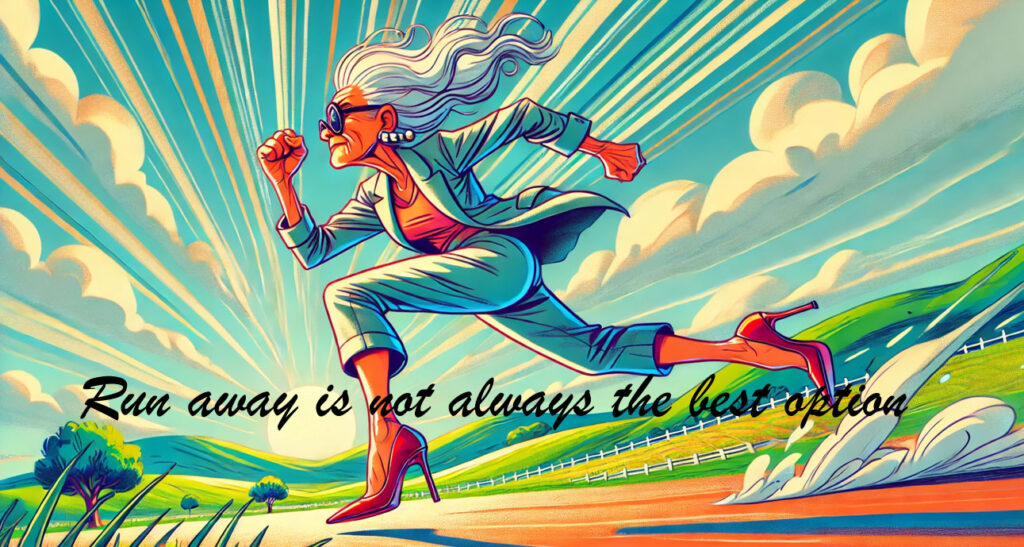
For example, there’s an old Chinese saying: “Of the 36 techniques, running away is the best.” But even that isn’t always true. What if the aggressor is younger and faster? What if your knee hurts that day? When was the last time you actually sprinted—and are you sure you won’t cramp up? Are you even warmed up to run? And what if you’re in an elevator with nowhere to go? Do you have the right shoes?

Asking Questions

When we were in school, the teacher or professor always seemed so knowledgeable, often asking questions that left us stumped. But remember—because they’re the ones doing the testing, it’s natural that we eventually miss something. If we were to question them in return, they might not have all the answers either.

In self-defense, the same idea applies: it’s important to be proactive rather than passive. Taking initiative can disrupt your opponent’s plan and make them reconsider their actions.

SCENARIOS

How to block a punch?

Remember, blocking should be your last resort, not your preferred option. We can break blocking into three key phases:

  • Noticing the Attack – You can’t defend against what you don’t see or feel. Train your awareness to recognize incoming threats early.
  • Before Contact – Once you detect an attack, there’s a brief reaction delay before your body moves. The time it takes for your hand to reach the target depends on both speed and distance. This is “overhead” time—it has no effect until contact occurs. To shorten this delay, keep your hands ready and avoid placing them in your pockets or behind your back.
  • At Contact – You won’t know your opponent’s strength until the moment of impact. Stay adaptable and responsive.
  • After Contact – Don’t rely on brute strength to move the opponent’s arm; strength against strength is inefficient. Instead, redirect or guide the incoming force away from your body. At the same time, move your target area—every inch of movement creates more space and safety

EXERCISES

Gallops

As kids, we all pretended to be horses and galloped around the playground. We’ll use that same idea for this mobility exercise.

  • Moving forward: Push into the ground with your front (leading) leg, then drag the trailing foot in.
  • Moving left: Push with your left (leading) leg, then drag the trailing foot in.
  • Moving right: Push with your right (leading) leg, then drag the trailing foot in.
  • Moving backward: Push with your rear (leading) leg, then drag the trailing foot in.

At the concept level, you always push with the leading foot. Using directional terms like front, left, right, or back can be confusing, but the key idea remains the same—the leading leg drives the movement.using. Using teams like leading and trailing takes us off that confusing translation.

Mental training is just as important as physical training. Many of you find it difficult to stay relaxed during emergencies—and that’s completely natural. It takes consistent practice and experience. Just like an emergency doctor, calmness isn’t something they’re born with; it’s developed through repeated exposure and training until staying relaxed becomes second nature.

Think and Review

Some ideas and suggestions:

  • Full-body tension and release: Tense all your muscles, then suddenly relax and exhale. This can also help warm you up on cold mornings.
  • Emotional control: When you feel irritated or angry, try exhaling and relaxing instantly—both physically and emotionally.
  • Mental review: Set aside time to read through the class notes, visualize the movements, and create your own summaries.
  • Body awareness: Often, you don’t realize when you’re tense. Try standing with slightly bent knees, breathing slowly and naturally, and consciously relaxing your shoulders, chest, and abdomen.

SSD – Class notes 2025-10-23

DISCUSSIONS
BODY WAVES

This exercise serves as an excellent general warm-up for the spine and the entire body. It opens the chest and relaxes the spine in a coiled position. While it looks quite different from Yoga’s cat-cow pose, it actually involves a similar spinal motion. Furthermore, you are also engaging the legs, abs, and neck as the wave motion ripples through the body. Developing control and awareness of each body segment moving sequentially provides valuable neural training for the brain.

Key-points

  • Push the knees forward.
  • Push the hips forward.
  • Extend the lower spine vertically.
  • Open your chest toward the ceiling by bending through the thoracic section.
  • Stand up through vertical with straight body
  • Then allow yourself to droop forward, starting from your head and then one vertebra at a time, while keeping the pelvis rounded and butt tucked.

Common errors:

  • Arching at the lower back instead of through the thoracic section of the spine.
  • Not pushing the hips forward enough.
  • Not moving one section of the body at a time.
  • When the body is ripping past vertical, you must keep the back and neck relaxed instead of tension.
  • Allowing the buttocks to stick out backward.

REALITY ABOUT STREET FIGHTS

  • There are no referees; you cannot tap out.
  • Even a push can be deadly if your opponent’s head hits the pavement.
  • It is not a game—there are no reset buttons.
  • Even on your best day, you may still get hit. Be prepared for pain; there’s no such thing as a free lunch.
  • You don’t know what you don’t know—the aggressor might have unseen friends.
  • A fight must never be about ego, anger, or teaching someone a lesson. It must be about protecting something more important than life itself.

PICKING TARGETS

Focus on soft, vulnerable targets such as the eyes and nose—areas that are especially painful and effective for self-defense.

When you are under stress, it is hard to manage things requiring a lot of precision. For example, you should not aim for an eye poke unless it is presented to you. Groin kicks, while effective, is well known and therefore you can miss if you telegraph.


SCENARIOS
A Frontal Push to the Chest

If you feel yourself stiffening up during training, it’s not good enough. This usually happens when the hips lock up or the panic reflex kicks in.

  • Using the body wave to absorb the force buys you valuable milliseconds.
  • Resisting the push directly often causes stiffness and creates leverage against yourself.
  • You must “step out of the firing line” as you perform the wave by spinning your pivot heel outward, then moving your other leg off the line as well.
  • If you feel yourself stiffening up during training, it’s not good enough. This usually happens when the hips lock up or the panic reflex kicks in


EXERCISES

  • Stationary Body Waves: Focus on smooth spinal motion without unnecessary tension.
  • Heel Spin: Spin the heel without lifting yourself up first. Make sure your heel, knee, and chest move as one.
  • Body Waves with Spin: Perform body waves while rotating around one leg.
  • Squat: Maintain control and grounding throughout the movement. Stay put until your legs burn and shake. Then count for another slow 8 count.
  • Projection Through the Fingers: Extend energy and intent through your fingertips as you move.

SSD – Class notes 2025-10-16

DISCUSSION

Relax

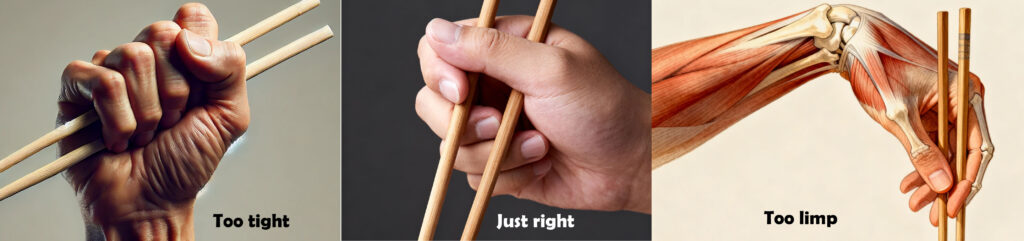
We often use the word “relax”, but here it has a specific, technical meaning. Take a look at the banner picture of the article: the “just right” state is neither tense (“fight mode”) nor limp. Neither extreme allows for effective handling.

The “just right” state is actually a range, and the only way to discover it and perfect it is through experimenting and practicing. You also need to understand the functional purpose of each movement and be adaptable to different types of food and chopsticks. As an example, when you pick up tofu with chopsticks, you can’t squeeze it like you would a piece of chicken — you must adjust your grip.

Key points to get out of wrist grabs without escalation

When we reviewed techniques for escaping wrist grabs, several key concepts were common across all of them:

  • Project through the fingers
  • Pivot point
  • Relax physically and emotionally
  • Flow with the force and find weakness.

To help you remember these, use the phrase “Please Practice Relax First.”

  • P – Please: Project through the fingers. Extend your arm with focused intent, as if energy is flowing outward. This helps create a stable and functional lever.
  • P – Practice: Pivot point. Keep your pivot point steady — it should not move or wiggle. It’s a key element in creating leverage.
  • R – Relax: Relax physically and emotionally. This helps you think clearly and avoid wasting effort by trying to move your opponent’s entire arm. It also prevents triggering their defensive reaction — your body language and mindset matter.
  • F – First: Flow with your opponent’s energy. For example, when your opponent grabs you, their fingers exert inward pressure. Instead of resisting outward, find ways to move inward without fighting it directly.

Weaknesses in the human grip

Fingers – We grab objects like groceries or tools by bending our fingers inward. To tighten our grip, we squeeze inward. If someone push my fingers inward, I am more likely to loose the grip.

Wrists – The wrist is strong on the palm side because it’s used frequently for lifting. The back of the hand, however, is much weaker since it rarely bears weight. While you can always train yourself stronger, but if you compare your own strength inward vs outward, you will find one direction is weaker.

Grip – When someone grabs your wrist, they aim to control you. If you remain relaxed, a single hand grip can only restrict you at the grip but not anywhere else — you can still move your fingers, smile, turn your head, or bend your knees. But if you tense up or panic, that grip will control your whole body.

Situational Awareness and Strategy

When we communicate, we express ideas and respond to the topic at hand — adapting our tone and wording depending on the situation or the person we’re speaking to. Sometimes we even use body language like a smile, a smirk, a wink, tension of the body, etc.

When it comes to fighting, a lot of people thought it is fundamentally different and expect to have standard solutions like the routine/form they practice everyday. When they are told “it depends…” and asked to understand the mechanics and concepts behind the technique, they think it is too complicated. But life is complex. Intelligent conversation — like martial adaptability — is difficult to both teach and learn.

Fighting is just another form of interaction, with higher stakes. Through martial arts, you’ll gradually understand not only yourself but also how others think and react.

SCENARIOS

High crossover wrist grab

Key Points

  • Relax and turn the wrist slightly so the palm faces downward.
  • Align your fingers with your opponent’s forearm.
  • “Wipe” 90 degrees with the fingers leading the motion.
  • Wrap and grab your opponent’s arm to steer them into a non-confrontational but strategic position.

Reviewed all the other grips learned so far

Through repetitions with different partners, you start to see the common thread that links all these together. You will also be able to remember the key-points that make it work instead of just imitating what may not be important.

Common Mistakes

  • Tensing the arm, causing the whole arm to move and sometimes even ended up trying to lift your opponent’s entire body. You should instead attempt to affect only his wrist and fingers.
  • Lifting the shoulder or elbow to “fight” the grab.
  • Forgetting to follow through to the strategic position.

EXERCISES

We didn’t have time for exercises together, but I trust you’re motivated to train on your own. Continue with the exercises from previous classes — your leg muscles and core could always use more work. Or maybe a simple plank for a couple of minutes.

SSD – Class notes 2025-10-09

DISCUSSION

Examples of things to do if you are early

  • Warm-up – Do a quick warm-up before class, since we won’t be doing it together as a group. You should already have warmed up a little before leaving home so that your body is ready for anything. A short warm-up helps you transition smoothly into training and prevents injuries.
  • Partner drills – Since class time is often used to cover new material, take advantage of the opportunity to practice with a partner when you can. Use this time to refresh your memory and test your reactions so that your responses become more instinctive and automatic.
  • Different partners -Each person’s height, weight, strength, and reactions are different. The more people you practice with, the more varied your experiences become, and the better prepared you’ll be for real-life situations.
  • Ask questions – If you have questions, ask them! Make the most of the time when I’m available to clarify techniques or concepts.

LRT (Listen, resources, target) – 3 pillars of self defense

Story: When I was coaching young kids, I noticed that I have much better success with them during class if I play some “listening games” right at the start. Once you can grab their attention through their urge to win the contest, half the battle is solved. By listening to their teacher / coach / parents willingly, you not only keep them safe, they are actively learning through listening better.

The SkyTrain’s original planning name was ALRT (Advanced Light Rapid Transit) or sometimes simply LRT. As an aid for memorization, we use the acronym LRT to represent the three major pillars of self-defense.

  • L – Listen / Look / Learn – These represent the tools you use to detect and anticipate danger. Always stay aware of your surroundings.
  • R – Your conditioning, training, knowledge, awareness of your environment, physical strengths, time, understanding of the opponent’s weaknesses, and even nearby strangers or traffic passing through—all are resources you can use. Effective self-defense is about maximizing your own resources while minimizing those of your opponent.
  • T – Target – This involves changing the WHO or the WHAT is targeted. For instance, pretend to have a conversation with a total stranger, redirect attention, or maintain a confident posture to make you a less appealing target. Ask yourself: What is your opponent’s likely goal or intended target? Can you alter or hide the target? Can you cause them to hesitate, reset, or redirect their focus?

Managing distance

If you are too close to a potential threat, you won’t have enough time to react or defend yourself effectively. When you notice someone suspicious, maintain a safe distance before anything happens. Staying aware of people and things around you—without being anxious or panicky—is an excellent habit for situational awareness.

SCENARIOS

Experiment: Strong support line vs perpendicular line

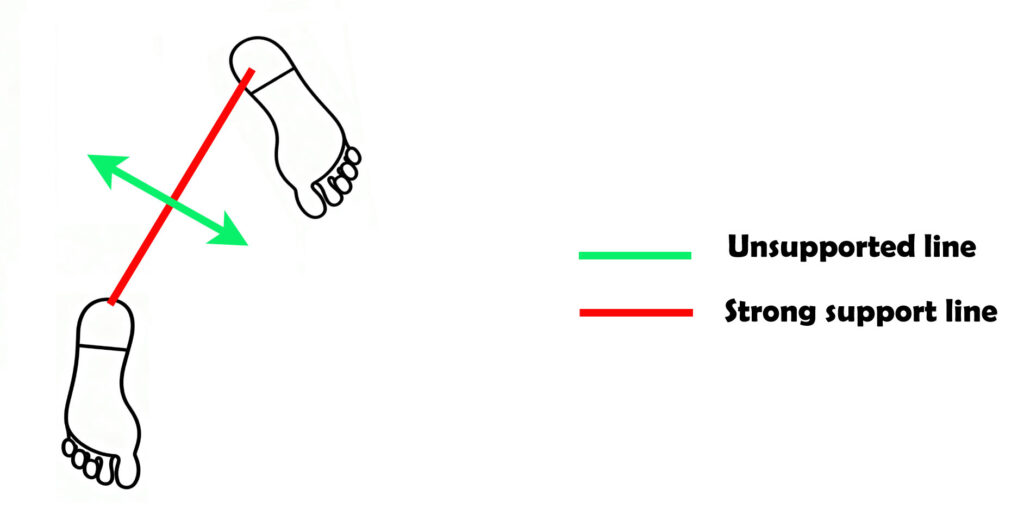
In the bow-and-arrow stance, the “strong line” runs heel-to-heel. Force applied along this line can be resisted more easily. However, pushing from the perpendicular line (relative to the heel-to-heel line) is much harder to resist and therefore has greater effect. Understanding this helps you control direction and stability.

Note: While the concept is “perpendicular (to the line of support), things doesn’t have to be exact. There is an tolerance of deviation base on your physical attributes like strength.

EXERCISES

Push the wall

This exercise develops a powerful push that comes from your whole body—not just your arm muscles.

Common mistakes:

  • Arching the back when you meet resistance, forgetting to engage your core for support.
  • Leaning in with straight arms, relying only on body weight instead of muscular strength.

Correct form:

  • Bend your legs slightly to engage your legs and glutes.
  • Keep your arms bent so your triceps can assist in the push.
  • Maintain a firm, supported spine and active abdominal engagement.

Arch the back / Pelvic Tilt / Normal relaxed position

Learning to control your tailbone and hip movement is essential—not only for martial arts but also for protecting your hips and groin during falls.

Posterior Pelvic Tilt:
Known as “tucking your tail under,” similar to a dog lowering its tail after losing a fight. In this position, the “bucket” tilts backward and the groin moves slightly forward.

Anterior Pelvic Tilt:
Commonly described as “sticking your butt out.” Imagine your pelvis as a bucket tilted forward when your tailbone sticks backward.

Practice Tip:
If you have trouble isolating your hip movement, place a cushion against the side of a table and press your hip into it—without moving your upper body. You’ll feel how the lower abs help move the hips forward or backward.

SSD – Class notes 2025-10-02

DISCUSSIONS

We don’t always have the luxury of having an extra 10–15 minutes before class to warm up or ask questions. However, we are fortunate that no one is ahead of us in the program. I encourage everyone to take advantage of this opportunity. Ultimately, fighting and survival are about the ability to see and make use of opportunities as they arise.

Structural versus muscular power

When you perform an action such as standing or lifting, you are of course using muscles—but the focus should be on the intent or function you are trying to achieve, not on the muscles themselves.

Bodybuilders, for example, tense muscles on both sides of a joint. This makes them look bigger but actually limits speed and fluidity of movement. Our goal is not to show off muscle size but to make movements effective and functional. This is called technical relaxation—using only what is necessary for the task without unnecessary tension.

A few key comparisons:

  • You don’t tire easily when relying on structural power. When relying solely on muscular power, fatigue sets in quickly unless you’ve trained specifically for endurance.
  • Structural power requires no reaction time when your body’s shape and alignment are already positioned to handle force from that direction.
  • As seniors, if you lack muscular strength, you must substitute it with power generated from other sources, as discussed below.
  • Muscles are still essential for daily activities such as standing, balancing, climbing stairs, and carrying groceries. Keep exercising to slow natural deterioration.
  • Those who bully you at your age are likely bigger and faster. Competing through muscle alone is not the best strategy—structure and technique are your advantage.

Escalate only when it is absolutely necessary

An ethical approach is paramount to acquiring fighting skills. You must understand the responsibility that comes with the skill. Any physical action, like punching someone, has repercussions. The mindset should be to start with the ‘gentle side’ rather than escalating a situation. This philosophy is a core part of the training, taught to prevent misuse of the skills learned.

Wavering between ‘fight-or-flight’ will guarantee a bad ending. You need to think ahead where your red-line is. Even if you decide not to fight, you must position yourself strategically: for example, maintain a good distance between you and aggressor; furthermore, are you repositioning yourself to a safe spot after every effortless skill? Can you redirect the body angles to something less aggressive?

Functional focus vs muscle contraction focus

When you stand, you don’t really know you are using muscles but you are. You don’t need to focus on naming the specific muscles or the contraction of any muscles. Any focus on tensing up any specific muscles is over doing it and may be applicable only if training those muscles is the purpose.

How to get yourself stronger?

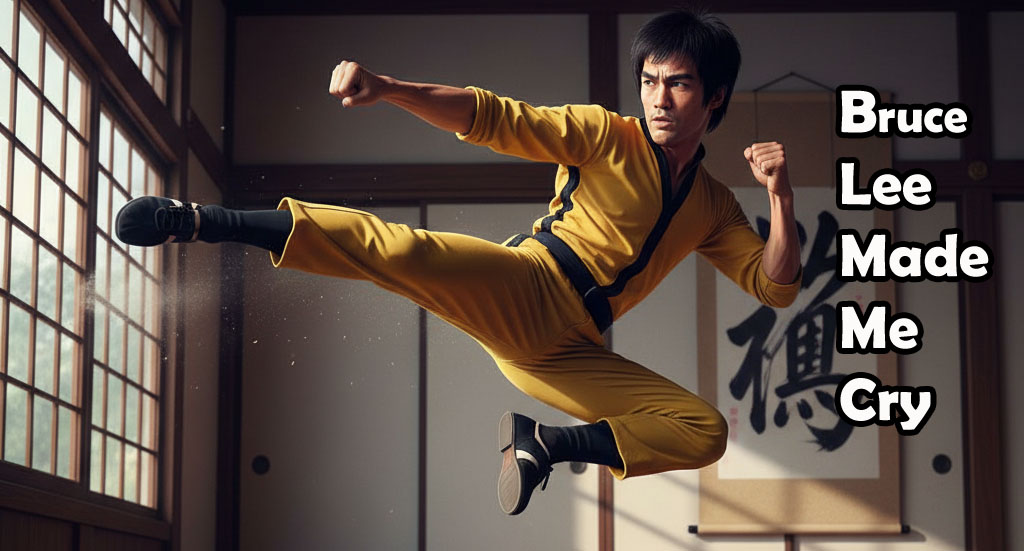
Remember this phrase: “Bruce Lee Made Me Cry.”
(The first letter of each word represents one of the key categories.)

  • B – Big muscles: These major muscles do most of the visible work. When training alone, people often focus only on these large muscle groups.
  • L – Little muscles: Smaller stabilizing muscles engage when the large ones tire out. Because they’re weaker and less coordinated, fatigue often shows as shaking in certain parts of the body.
  • M – Mind: We demonstrated the power of the mind through the firehose projection experiment. Changing what or where you focus dramatically alters the outcome.
  • M – Mechanics: Familiar principles such as leverage, angles, and structure all influence how efficiently you use your strength.
  • C – Coordination: The difference between a trained unit of soldiers and an unorganized group is coordination. When an order comes, trained soldiers act cohesively. Likewise, a trained body functions as a coordinated team—each part working in unison toward a single goal.

By projecting your intent and structure together, you force the opponent to deal with your entire body’s mass and alignment, making your technique far more effective.

SCENARIOS

“Being shoved from behind (or pulled from front)”

  • Go with the flow to absorb the force
  • Push the butt backwards to counterbalance the forward momentum of the upper body
  • DO NOT start with bending your leg as that accelerates the descend
  • Each of the following help reduce the impact of the fall: 1) going with the force helps reduce the force forward 2) pushing the butt back help reduce the weight on the front of your support 3) halving the body helps reduce your height 4) the net of the velocity backward and the upper body pushed forward is a lot less

If you have trouble distinguishing between pushing your butt back and leaning your upper body forward, stand about eight inches from a wall or similar obstacle. Then, gently push until your buttocks touch the wall—without leaning into it. Your upper body should lean forward just enough to counterbalance the backward motion of your hips.

“Two hands on shoulder” – We used this scenario to show how you can neutralize a much stronger opponent’s grip without direct resistance. The key mechanic here is similar to a door stopper or a pebble in the track of a sliding door—a small but strategic action that disrupts movement.

“What if it change to grabbing your shirt?” – When a conflict escalates to a point where an effortless solution is no longer possible, you may need to respond more assertively. For example, I might reach out and press on the opponent’s throat while stepping toward them to regain control and space.

EXERCISES

You don’t always have a partner feeding you pushes or grabs. So it is important to be able to work independently as well as work with a partner when you have a chance.

Reference points and projection – When discussing leverage systems, there is always a pivot point—like the center of a seesaw. The pivot remains fixed, and the board must be straight and strong. We simulate this by projecting a line of force from the belly button through the fingers. In some cases, such as the door stopper example, you need to prevent the opponent from moving with you to create an opening for escape.

Isolation and integration of different body parts – Work on moving individual parts of the body independently. For example:

  • Draw circles with your shoulders, both forward and backward.
  • Try arm circles—one arm forward while the other moves backward.

Caution: Move slowly and mindfully. Don’t hurt yourself.

Squat – Stay in a squat position until your legs start to burn and shake, then sustain it for an additional count of eight. This builds both strength and mental endurance.

Do you know why we keep the back parallel to the ground in this squat?