
DISCUSSION
Examples of things to do if you are early
- Warm-up – Do a quick warm-up before class, since we won’t be doing it together as a group. You should already have warmed up a little before leaving home so that your body is ready for anything. A short warm-up helps you transition smoothly into training and prevents injuries.
- Partner drills – Since class time is often used to cover new material, take advantage of the opportunity to practice with a partner when you can. Use this time to refresh your memory and test your reactions so that your responses become more instinctive and automatic.
- Different partners -Each person’s height, weight, strength, and reactions are different. The more people you practice with, the more varied your experiences become, and the better prepared you’ll be for real-life situations.
- Ask questions – If you have questions, ask them! Make the most of the time when I’m available to clarify techniques or concepts.
LRT (Listen, resources, target) – 3 pillars of self defense
Story: When I was coaching young kids, I noticed that I have much better success with them during class if I play some “listening games” right at the start. Once you can grab their attention through their urge to win the contest, half the battle is solved. By listening to their teacher / coach / parents willingly, you not only keep them safe, they are actively learning through listening better.
The SkyTrain’s original planning name was ALRT (Advanced Light Rapid Transit) or sometimes simply LRT. As an aid for memorization, we use the acronym LRT to represent the three major pillars of self-defense.
- L – Listen / Look / Learn – These represent the tools you use to detect and anticipate danger. Always stay aware of your surroundings.
- R – Your conditioning, training, knowledge, awareness of your environment, physical strengths, time, understanding of the opponent’s weaknesses, and even nearby strangers or traffic passing through—all are resources you can use. Effective self-defense is about maximizing your own resources while minimizing those of your opponent.
- T – Target – This involves changing the WHO or the WHAT is targeted. For instance, pretend to have a conversation with a total stranger, redirect attention, or maintain a confident posture to make you a less appealing target. Ask yourself: What is your opponent’s likely goal or intended target? Can you alter or hide the target? Can you cause them to hesitate, reset, or redirect their focus?
Managing distance
If you are too close to a potential threat, you won’t have enough time to react or defend yourself effectively. When you notice someone suspicious, maintain a safe distance before anything happens. Staying aware of people and things around you—without being anxious or panicky—is an excellent habit for situational awareness.
SCENARIOS
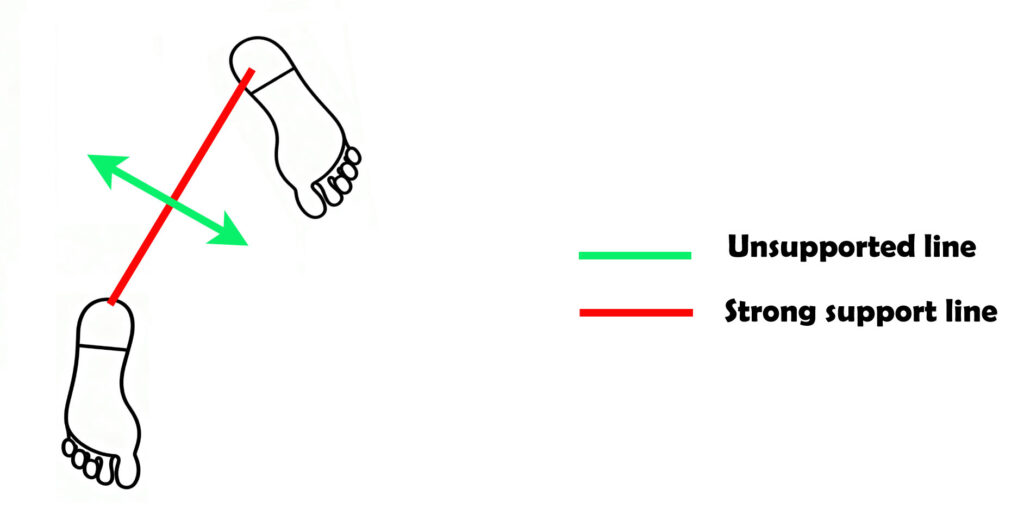
Experiment: Strong support line vs perpendicular line
In the bow-and-arrow stance, the “strong line” runs heel-to-heel. Force applied along this line can be resisted more easily. However, pushing from the perpendicular line (relative to the heel-to-heel line) is much harder to resist and therefore has greater effect. Understanding this helps you control direction and stability.
Note: While the concept is “perpendicular (to the line of support), things doesn’t have to be exact. There is an tolerance of deviation base on your physical attributes like strength.
EXERCISES
Push the wall
This exercise develops a powerful push that comes from your whole body—not just your arm muscles.
Common mistakes:
- Arching the back when you meet resistance, forgetting to engage your core for support.
- Leaning in with straight arms, relying only on body weight instead of muscular strength.
Correct form:
- Bend your legs slightly to engage your legs and glutes.
- Keep your arms bent so your triceps can assist in the push.
- Maintain a firm, supported spine and active abdominal engagement.
Arch the back / Pelvic Tilt / Normal relaxed position
Learning to control your tailbone and hip movement is essential—not only for martial arts but also for protecting your hips and groin during falls.
Posterior Pelvic Tilt:
Known as “tucking your tail under,” similar to a dog lowering its tail after losing a fight. In this position, the “bucket” tilts backward and the groin moves slightly forward.
Anterior Pelvic Tilt:
Commonly described as “sticking your butt out.” Imagine your pelvis as a bucket tilted forward when your tailbone sticks backward.
Practice Tip:
If you have trouble isolating your hip movement, place a cushion against the side of a table and press your hip into it—without moving your upper body. You’ll feel how the lower abs help move the hips forward or backward.