
DISCUSSIONS
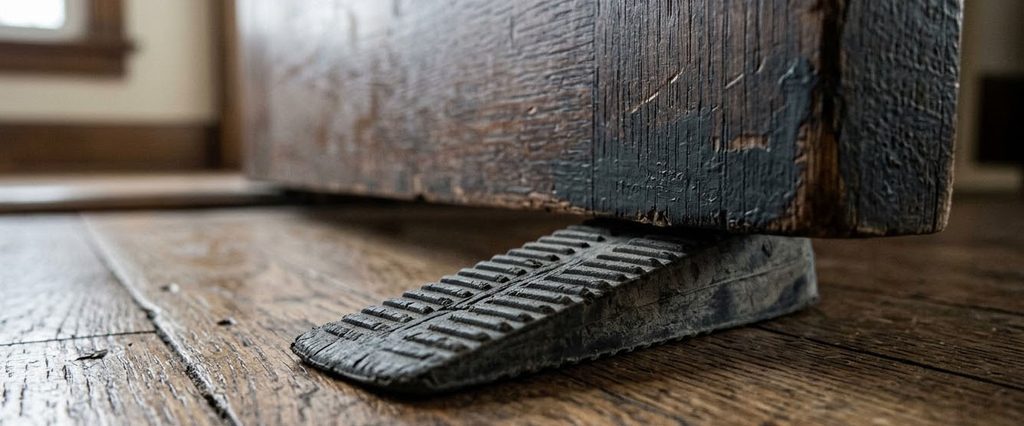
The “Doorstopper” Concept: – preserve your defensive space
In martial arts, the “doorstopper” concept means that instead of directly pushing back against an opponent’s force, you try to jam or redirect their movement so they cannot reach their intended target. When you push head-on against someone who is stronger than you, they will usually have the advantage.
If you retreat, the aggressor may take advantage of every inch of space you give up. Therefore, this concept should be applied in a way that preserves the space you need for your defense. Rather than meeting their force head-on, redirect it to the side and avoid a contest of strength.
Body Relaxation and Breathing
If you tense up your body while being pushed, you are creating a leverage advantages for the attacker. You will find that a properly relaxed body is more effective in absorbing the incoming force.
If you tense up while being pushed, you may create mechanical advantages for the attacker. A properly relaxed body can be more effective at absorbing and adapting to incoming force.
If you exhale quickly and forcefully, you may be able to absorb some of the incoming force more effectively. Furthermore, exhaling can help create space for defensive movements. However, you must be careful not to give up this space carelessly, as your opponent may take advantage of every inch you yield. Apply the doorstopper principle to maintain your defensive space.
Controlling Your Opponent’s Mind
You may be able to disrupt an attack by changing the opponent’s thought process or drawing their attention elsewhere. This could involve doing something unexpected, such as not resisting a push, introducing a new variable, such as calling out to someone, or directing their attention toward other people or things.
It is important to practise recognizing the resources already available to you. Don’t wait until you need them and then panic. The more you practise, the easier it becomes to recognize and use these resources.
SCENARIOS
Back against wall
What is the difference between being pushed when you have room to move and being pushed against a wall or onto the ground? The key difference is your ability to move.
If you tense up and fight the incoming force, simply taking steps backward may be enough to neutralize the push. However, if there are obstacles behind you, you cannot move as freely. Learning how to “find space” is therefore very important.
Tagging
The concept of “tagging” involves freezing your opponent physically or mentally.
From a physical perspective, this can mean affecting the opponent’s balance, muscle tension, or ability to move. From a mental or psychological perspective, it can involve creating pressure, triggering an overreaction, introducing fear of consequences, redirecting attention, or influencing their willingness to fight.
This goes beyond feinting, baiting, or misdirection. Through subtle actions, such as a slight shift or touch, you can influence your opponent’s posture and balance, encouraging predictable reactions or commitment to a particular direction.
Tagging extends beyond physical techniques to include an understanding of human psychology. You can disrupt an attack by changing the opponent’s thought process. This might involve doing the unexpected (e.g., not resisting a push), introducing a new variable (e.g., calling out to someone), or using reverse psychology (e.g., telling someone not to do something, knowing they may be more inclined to do it).
For example, a quick movement in one direction may trigger your opponent’s instinct to resist. This resistance will usually be in the opposite direction, and you can choose to work with that response rather than fight against it.
Pushing
Most people push using only their arms, which limits the force they can generate to the contribution of their arm muscles. In combat, our aim is to make the best use of our whole body without exposing ourselves to unnecessary risks by overcommitting.
To accomplish this, we keep our elbows locked or nearly locked, minimizing arm extension. The driving force comes from the feet, with the whole body moving as one unit toward the opponent.
The body needs to remain relaxed while releasing force, all while maintaining a vertical axis. Changes in the direction of the force are controlled through the palms and fingers.
Absorbing
Winter is coming, and we will all be wearing thicker clothes. This can affect the energy transferred during impact, meaning that even your best punch may not produce the intended result. Similarly, a thick layer of body fat can provide some cushioning against impact.
These factors need to be taken into account during combat, as they affect both your strikes and your defenses. When considering an attack, remember that different parts of the body have different levels of protection. Thick clothing may provide some cushioning, but it does not reliably protect vulnerable areas such as the head, nose, or throat. From a defensive perspective, extra clothing or body fat may offer some protection against certain impacts, but you should never assume that you can safely take more hits or afford to take greater risks.
People with well-developed abdominal muscles can tense them to help protect their internal organs from impact. However, this protection has its limits and depends on the muscles’ ability to withstand the force.
Rather than simply stiffening your muscles, you need to learn how to absorb incoming force by changing the angle of impact, relaxing your muscles, and allowing your body structure to adapt immediately. These adjustments can help dissipate the incoming force rather than allowing it to concentrate in one area.
EXERCISES
Yes, we need to continue doing the foundational exercises I have shown you in the past to improve arm, core, and leg strength, cardiovascular fitness, joint mobility, and balance.
On top of that, we need to train our ability to control different parts of the body. This means learning how to integrate them so that the whole body works as one unit, while also being able to move individual parts independently when needed.
This is a lifelong journey. The more time you invest in it, the more you will learn and the more easily and quickly you will be able to perform these movements.
The following is not an exhaustive list, but rather a collection of examples. If you are unfamiliar with any of them, please ask!
- Finding Space Through Breathing
- Practising the “Doorstopper” Concept
- Step and Sink
- Pushing Against the Wall
- Galloping Without the Up-and-Down Movement
- Changing Angles
- Leg Switches
- Fish Tail
- Body Waves
SIDE NOTES
Do read the Confederation notes. 🙂