DISCUSSION
Relative Distance
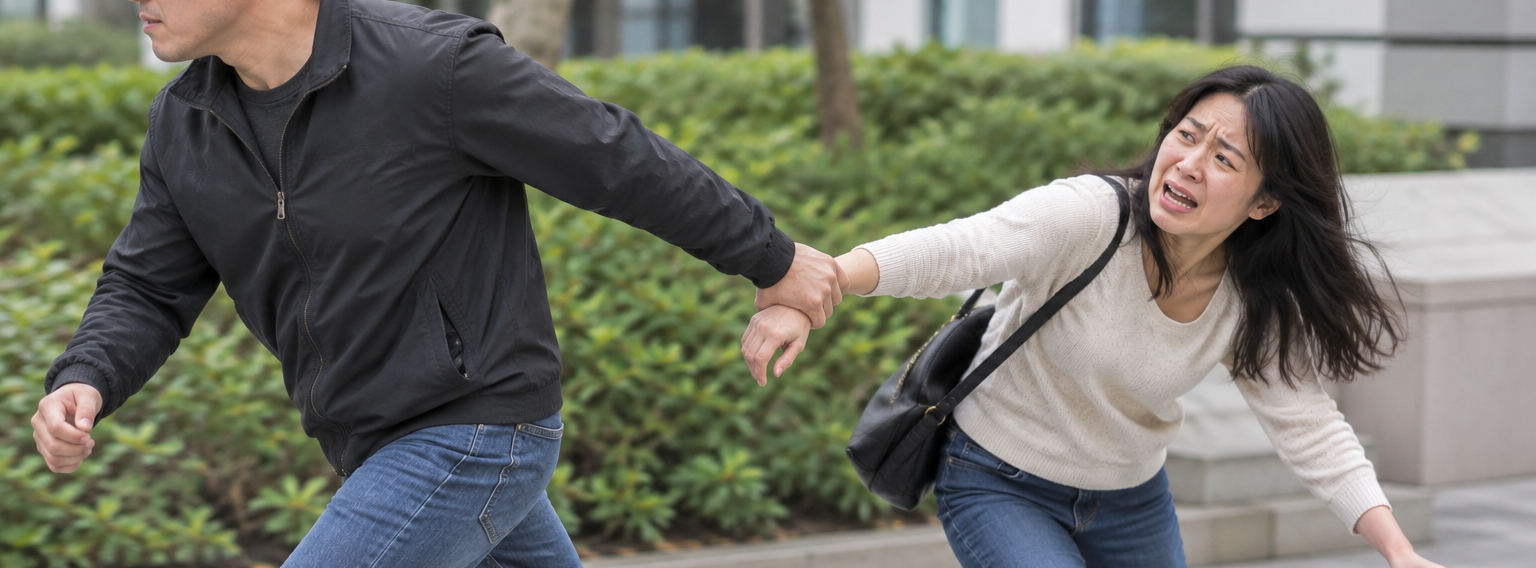
We experimented with changing the distance between ourself and the aggressor by having the aggressor pull while grabbing the wrist. We quickly discovered that when there is continuous tension through the grab, the technique did not feel the same. In fact, the change can be significant enough that you may find you cannot get out, or that you have to brute-force the technique to make it work. This is due to you not being able to maintain a constant distance you and the aggressor.
If however, you step forward or extend the arm to maintain the same tenson while the aggressor grabbed and pulled, then the “relative distance” and therefore the “tension” can be maintained . The escape technique will then feel more like how it was when you drilled with a static partner.
Relative Speed
It is not enough to simply move forward in response to the pull. You have to move fast enough to catch up with the aggressor’s movement. So, if the bully is stronger and faster than us, how can we compensate for the difference?
In self-defense, you do not have to be the fastest person on earth. You only have to be faster than the aggressor in that specific instance.
Furthermore, self-defense is not a sport, so do not feel embarrassed about “cheating.” The aggressor is the one creating an unfair situation by choosing to bully you. Use whatever advantage is available to you.
Here are some examples of situations where a person who is normally faster can be put at a disadvantage:
- He is moving backward while you are moving quickly forward.
- You do not give him advance warning, and you do something he least expects.
- You have a shorter distance to travel.
- He is distracted or in a position where he cannot move easily.
- And there are many other possibilities.
SCENARIOS
Grabbed along, facing the same direction
The thumb plays a very important role in a strong grip. If you look at how a grip works, the fingers are all closing inward, not outward. Therefore, instead of resisting the expected way by trying to yank your hand out, you should press against his thumb in its weak direction.
Various Grip Escapes
We find that many of you still start an escape by “fighting” the grip, rather than first identifying the vulnerabilities of the grip you are being held with.
As the defender, you need to amplify your own resources while taking resources away from your opponent. For example, take away the space available for him to move and deflect; amplify your power by using good mechanics; and use your entire body to localize the effect onto just one finger, rather than working against his entire body weight and muscular strength.
Do NOT Lean
A lot of the time, we have the impression that if we lean into our movement, we are adding more body weight to our delivery. In reality, the mechanics work in the opposite direction.
Leaning your body at a 45-degree angle reduces the amount of your body weight that can be effectively delivered, similar to the way a hand truck or dolly is tilted when moving a heavy box.
If you keep your spine close to the vertical axis, you can use much more of your body weight in your delivery—potentially close to 100%—rather than allowing part of your weight to be directed downward or otherwise lost through your posture.
Responding to Pulls
If you tighten up when someone tries to pull you forward, you will be fighting directly against their force. You will lose if they are stronger.
Instead, you should “relax” your arm and body like a bungee cord, while guiding their force around you. The bungee-cord effect, combined with a change in direction, reduces the effectiveness of the pull because the force is no longer being applied in its original direction.
EXERCISES
Integrate training into everyday activities like going up the stairs, the push through the legs when you push the lawnmower, or walk long steps driving through every step. Do practice slow and be mindful when you are trying to learn new things or to change some old habits.
Use simple props to help you train – For example, push a static wall driving through the legs, squeeze hard with a pillow in between your legs to train your inner thighs, use a static object like the wall or a chair to see that you are not moving a pivot away from where it should be.
SIDE NOTES
Class notes for Confederation Park has been posted as well. Go check it out. Find any differences? Let me know what you think.