DISCUSSION
Why Practice with Sticks?
Many people first encounter sticks as simple objects for play. However, learning to use a stick goes far beyond fun or fighting.
Training with a stick is an engaging way to develop hand-eye coordination. It also serves as an effective tool for building strength in the hands and arms. Because of its simplicity, it is a convenient training implement that can be used almost anywhere.
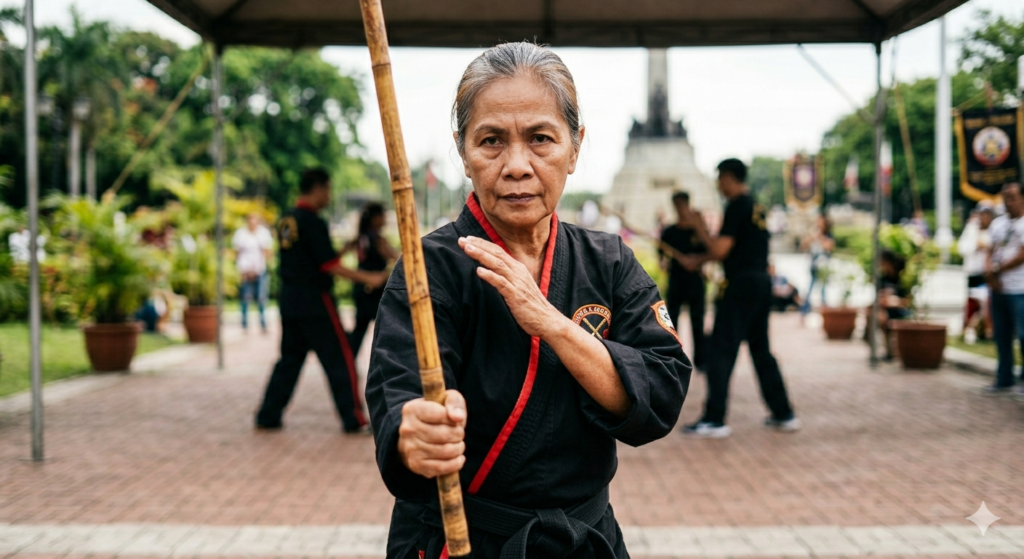
With proper practice, you begin to appreciate the amount of power a stick can generate. While others may underestimate a person’s empty-hand striking ability, they tend to be far more cautious when a stick is involved—especially in the hands of someone who appears skilled.
Because a stick can move quickly, it becomes especially important to develop mobility and the ability to reposition both yourself and the target.
A stick is also one of the most accessible tools you can carry or find in everyday environments. However, it must be treated with respect. As the saying goes, “Do not take it out unless you intend to use it.” Use it responsibly and with control—never carelessly or abusively.
Basic Striking Patterns and Strikes
The stick skills taught here are derived from Filipino Arnis, simplified to make them easier to learn, retain, and apply.
There are two primary types of strikes:
- Snap (or knock): The stick recoils immediately upon contact with the target. These strikes are used to stun or distract. When applied to sensitive areas such as the opponent’s fingers, they can cause them to lose grip of their weapon.
- Follow-through (hit and swing through): Similar to swinging an axe, the strike continues through the target. This generates heavier impact and delivers more force.
The following are the fundamental movement patterns:
- Diagonal patterns: Letter X (or figure-eight), performed in both natural and reverse directions
- Helicopter / fan (abanico)
- Horizontal strikes
- Vertical strikes (downward and upward)
- Thrusting (stabbing) actions: using the front end of the stick (dulo) or the butt end (punyo)
The Stick Grip and Handling
The stick should not hang loosely from the arm, but it also should not be gripped too tightly. Maintain a balanced grip—secure enough for control, yet relaxed enough in the fingers and wrist to allow the stick to whip through the air. If your grip is too tight, you will restrict speed and fluidity, making it difficult to generate proper snapping motion.
Although a stick does not have a cutting edge like a blade, the system is based on the idea that the same mechanics can translate to edged weapons. With that in mind, align the second joints of your fingers as if they represent the cutting edge, always oriented toward the target.
After each strike, you should “park” the stick in a controlled position. This builds the habit of always knowing where your weapon is. While it may seem minor, poor control can cause the stick to rebound unpredictably potentially resulting in self-inflicted contact or accidental injury to others nearby.
Your non-weapon (guard) hand should remain active at all times unless performing a specific action. Keep it positioned in front of your chin or neck, facing outward, ready to protect or assist as needed.
Numbering System for Ease of Reference
Having a numbering system is both good and bad. Once you repeat it enough times, then it is not a problem. However, it is a problem when there is more than one numbering system. To switch between the different system will be very confusing.
I am teaching sticks to seniors and I don’t want to over burden them with complexities that doesn’t offer a lot of value unless they are planning to live and breath it and make it their profession.
So our simple system is always from the striker’s point of view. Right are all odd numbers and even number is the left. We will simply start with 4. One is high-right. two is high-left, three is mid-right, four is mid-left. We will add more over the weeks.
SCENARIOS
Partner overhead helicopeter drill
This drill develops coordination between the elbow, body movement, and an overhead wrist-driven strike. The goal is to generate a controlled “flicking” motion from above.
Maintain visual focus on your target at all times. Your partner will hold a stick upright as a reference point. Aim precisely and strike the target using the overhead helicopter motion, ensuring the movement is driven by proper body alignment and a relaxed, snapping wrist rather than excessive tension.
Practicing the Strike (Power, Distance, Angle, and Guard)
Developing strength in the arms, wrists, and hands is essential and will improve over time with consistent practice. Repeating the basic striking patterns with a stick helps build the necessary attributes.
Provide a smaller target by tucking in your chin, rounding your back and bending the knees and facing your opponent at a slight angle. Stick are fast because of the amplification of the hand and body speed through the arc of travel.
A common beginner mistake is relying on just the arm for power while maintaining a stiff body and shoulder. Instead, allow the entire body to contribute to the strike. Power should originate from the hips, not from twisting the waist in isolation. As the hips rotate, one foot should turn with the knee and pivot on toe while the other side provides a stable anchor and stay grounded.
Proper distance and angle are also critical. If the target is low, adjust your level by lowering your body so your shoulder is closer to the height of the target. If the target is high, avoid simply reaching upward with your arms. Instead, raise your body so the stick remains closer to a horizontal line. This is important because your effective reach is greatest when the arm and stick are aligned horizontally; reaching too far up or down reduces both reach and structural efficiency.
Level changes can also be used as a tactical tool. You can feint high and then quickly change levels by rising or dropping your stance. Combined with stick speed, wrist-driven redirection, and footwork adjustments, this makes your strikes significantly more difficult to anticipate and defend.
Always remember the importance of controlling the “blade edge” throughout the entire strike, right up to the moment power is delivered to the target.
A common beginner mistake is rotating the wrist too early, causing the strike to land with the “back side” or at an inconsistent angle. This misalignment reduces effectiveness and can cause the stick to glance off or lose control upon impact.
Maintain awareness of your guard hand throughout, ensuring it remains active and ready unless intentionally committed to another action.
EXERCISES
Do all the body conditioning drills plus work on the stick moves so that it is not foreign to you. Use the whooshing sound as feedback to know if you are striking with acceptable speed. Furthermore, add the following variations:
- Level changes
- Zigzag steps forward and backward
SIDE NOTES