
DISCUSSION
Using an Attacker’s Force/Redirecting Force: This principle focuses on redirecting an opponent’s momentum and force against them rather than meeting it with direct opposition. The core idea is to move with their pull or push, adding your own force to unbalance them, turning their aggression into a disadvantage. This helps amplify the effects of your delivery system, for example, if he is crashing into your direction, a hit in the opposite direction means that he is crashing into your hit and therefore the effect is the sum of your power AND his fall.
The Perpendicular Line Principle: This principle leverage off observing or feeling your opponent’s line of support. A line perpendicular to his line of support is where his support will be minimum and therefore becomes a vulnerability you can take advantage of. This disrupts their balance much more effectively than direct point-to-point opposition, requiring less strength. When someone loses his balance, his top priority instinctively is to attempt to rebalance, this help limit his options as well as his focus.
Small Joint Manipulation (Thumb Lock): This technique involves isolating a small joint, specifically the thumb, to gain control over an opponent. By pressing on a pressure point on the thumb and twisting it, one can inflict pain and force compliance, demonstrating that significant control can be achieved with minimal effort by targeting vulnerable areas.
The exposure you have regarding any type of locks is that there is a certain percentage of the population that has really flexible fingers. This means that it will take a lot more effort before you find the pain-point of another person and therefore may be easier to get out from that class of people.
Wrist Lock: This is a joint lock that involves controlling an opponent’s arm by bending their wrist and rotating their forearm. The key is to create a pivot point and apply pressure to spin the bones in the arm, locking the elbow joint. It’s a powerful control method that can be executed quickly and is effective even against larger opponents.
Strategic Use of Strikes (Nose Strike): This is a counter-attack strategy focused on disrupting an opponent’s composure and vision. A palm heel strike to the nose bridge causes an involuntary physical reaction (tears, disorientation) and obstructs their view, creating an opening for escape or further action.
Importance of Communication in Training: This logistical point emphasizes the necessity of clear verbal feedback (or double tap or saying “it hurts”) during partner training to prevent injury and ensure effective, safe learning. Especially for joint locks, if the angle is not correct, the person applying the technique will not know for sure whether it is done correctly without the feedback. As the person applying the technique, it is very important NOT to do it fast as you can cause damage or injury to a partner that is helping you train.
SCENARIOS
Falling
Unhooking a Tripped Foot: This is a specific procedure to recover from a trip by immediately using abdominal muscles to lift the tripped leg, rather than trying to push off. The goal is to quickly free the foot to take the next step and prevent a fall.
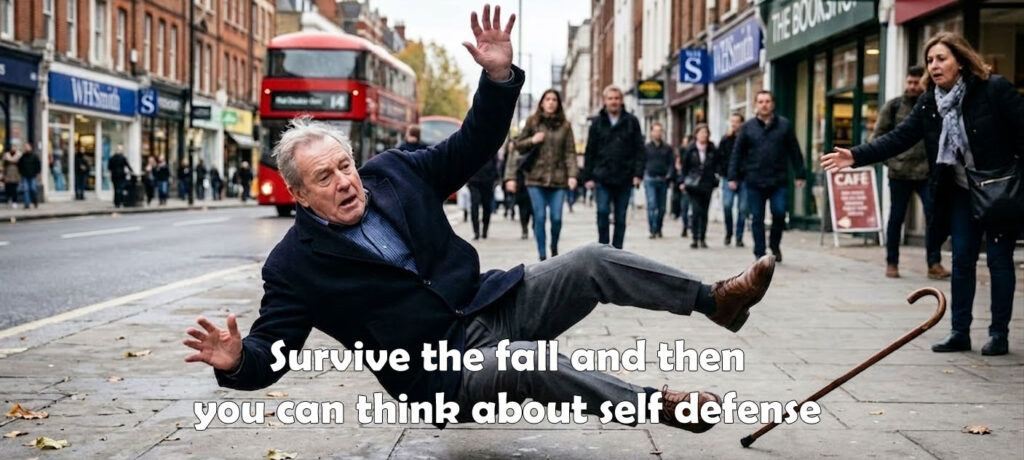
Proper Rolling Technique / Safe Falling: This is a fundamental movement skill focused on protecting the body during a fall or impact, such as crashing into a wall or a heavy fall onto the ground. The key principles are:
Roll to spread the impact over a bigger surface area – To roll, you must provide a sideway force on contact to get your body to roll.
Protect vulnerable, bony areas of the body, such as the heel of the palm, elbows, shoulders, knees, and tailbone. These should either be kept rounded or repositioned so that impact is absorbed by the softer, more muscular parts of the body—for example, allowing the fleshy part of the arm to take the force rather than the tip of the elbow.
Protect your head at all times—any direct impact to the head is unsafe.
Falling Backward
This simulation of a backward fall against the wall is to remove the fear of falling backward as well as to highlight the most vulnerable points from the fall. Key-points to note:
- Your head – Injury to the head is no joke. You simply must protect this even if everything else fails. So make sure you are rounding the back with the nose pointing towards your belly button.
- Your tailbone – if your spine and tailbone is point downward perpendicular to the ground, it will fracture and you will be great pain for a few months. Do push you knee forward and hip forward to help counterbalance the backward fall.
- Do not relax until everything comes to a complete stop – if you release too early, it will have a whipping effect.
EXERCISES
Fall simulations must be practiced consistently so the response becomes automatic. If you need a refresher, refer to the front fall video on the SeniorsCorner – MartialGym YouTube channel. Practice the following scenarios daily:
- Front fall against a wall
- Front landing followed by a roll to the side against a wall
- Backward fall landing against a wall
- Tripping recovery (reset)
SIDE NOTES