SSD – Class notes 2025-06-12

DISCUSSION

Last class until September

Today is the last class until September. The focus of today’s session was to teach some important exercises that will help establish a solid foundation for the new season.

During the session, we emphasized the efficiency of movement—generating maximum effect with minimal effort. However, this doesn’t mean training isn’t required. You still need to practice in order to program your nervous system so that responses become automatic.

You need muscles to carry groceries or help lift others. You need resistance training to see if you can maintain sustained pressure against an opponent. You need to bear weight to strengthen your bones, joints, ligaments, and more.

Summer is a great time to enjoy the sun—and also a great time to keep up with relevant training.

SCENARIOS

We did not have time to do scenarios. Do read all the notes available on this website.

EXERCISES

Consistency is key with all of these exercises. Try marking on your calendar the days you complete your workouts—it’s a form of positive reinforcement when you see your calendar filled with check marks.

The plank is a great exercise for training most of the muscles in your body to work together, helping you generate whole-body power. A common challenge for beginners is that when they execute a skill, they only copy the outlook of the move and forget about maintaining suitable tension for the rest of their body. Gaining control over your entire body is fundamental in all martial arts styles.

Here are some common mistakes to avoid when doing a plank:

  • Core not engaged, causing the belly to sink or the lower back to arch.
  • Hips raised too high, forming a triangle shape. Your body should form a relatively straight line from shoulders to heels.
  • Shoulders behind the hands instead of stacked directly over them.
  • Arms locked out, relying on skeletal support rather than muscular engagement. Keep a slight bend in the elbows to engage your triceps and better connect to pushing/punching mechanics.
  • Elbows flared out instead of close to the body. In a guard position, elbows should protect the ribs. Keeping the elbows in also allows the shoulders to relax more naturally, improving endurance and form.

At first, holding the plank position can be challenging. The body weight pressing onto the wrists might feel uncomfortable—but this discomfort is necessary training if you want to develop the ability to deliver powerful palm strikes, such as into an opponent’s nose.

Leg Raise Exercise

Stand with your back flat against a wall. Keep your body upright and your support leg vertical. Slowly raise one leg in front of you while keeping it straight. When you reach your maximum height, pause—and then try to lift it just one more inch. You’ll feel your quads burn almost immediately. Once your leg starts to shake, begin counting to eight, then lower the leg in a controlled manner. Repeat with the other leg.

Key points to keep in mind:

  • Your entire body must stay vertical against the wall. Avoid leaning back or tilting your torso to help lift the leg.
  • Toes can point outward and stay relaxed—this isn’t a flexibility or stretching exercise.
  • If your quads or hip flexors cramp up, perform the runner’s stretch, extending the cramping side behind you to release the tension.

Shift and slide
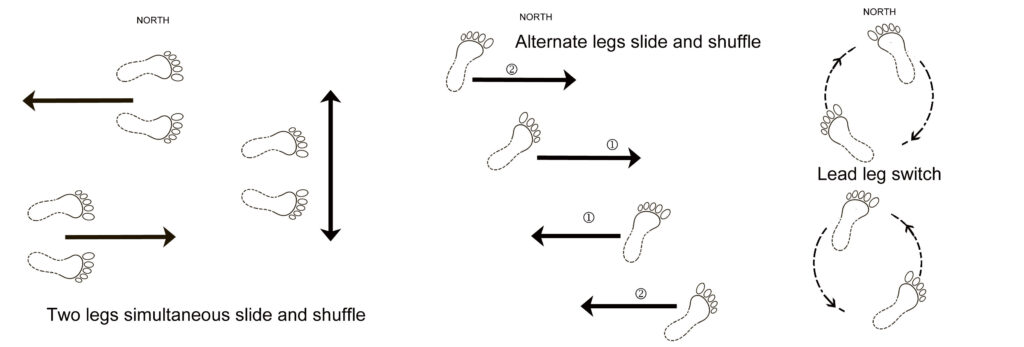
We did the prep moves which simply bend the knee and lift the heel up. We activate the calf muscles by bouncing on the ball of our foot and landing on the ball of our foot.

  • With chest facing sideways (east) and head looking (north) over your shoulder, you shuffle both legs simultaneously backwards. Then you practice shuffling forward
  • With the left leading leg, move your right leg sideways first, dragging your left leading leg sideways in the same direction. Remembering which leg goes first may be too hard to remember, simply think open wider and then drag to follow versus using the numbers as in the illustration..
  • With a left front leading leg, use the hip to move the entire body around so that the right leg becomes the leading leg.

Common mistakes

  • Simultaneous shuffle becomes a step-step two beat stepping.
  • During the alternate leg slide, the front leg over stepped and the legs get all crossed up
  • During the lead leg switch. only the foot moved, the body remains static. The chest should switch WITH the hip. The head remains facing North.
  • You should not be jumping up and down, you should instead be sliding at the same level using mostly your calf muscles.

Prep for mobility

You may notice that the illustration above includes dotted lines in the heel area. This is to emphasize that the heel is slightly off the floor, with most of the weight resting on the ball of the foot. If you watch high-level sports like tennis, where quick movement is essential, you’ll see that almost every player moves on the balls of their feet. This positioning allows for faster and more agile movement.

If you’re learning to jump, start by practicing landings on the balls of your feet after a small hop.

To develop explosive power in your calves and feet, in addition to standard drills like calf raises, try hopping directly upward from a straight-legged position, pushing off using only your feet, calves, and toes. This exercise is excellent for developing quick, non-telegraphed movements. However, you have to land on the ball of your feet. If the landing still create a shock to your legs, you are allowed to add the landing with bent knees.

SSD – Class notes 2025-06-12

DISCUSSION

Why self-defense or fighting arts can be a lifetime journey

Our bodies are made up of many muscles and joints. With so many possible combinations, tasks can often be accomplished in more than one way. During our session, we also observed that a person’s intent can affect how a movement is executed. Add to that the external variables—your opponent’s dimensions, body weight, speed, thoughts, knowledge, intent, and more—and it becomes clear that success isn’t about fixed formulas. What matters most are the relative factors: your strengths and weaknesses compared to this specific individual.

Additionally, your ability to adapt and respond improves over time as you face different stressful situations—much like the difference between a seasoned lawyer and a rookie. That is the reason why training with different partners is important. Experience shapes not just what you do, but how effectively and confidently you do it under pressure.

In a video game, if a move doesn’t work, you usually have more chances—and in the worst case, you can just restart the game. But in self-defense, the stakes are much higher. Sometimes, you only get one chance—and you must capitalize on it when it comes.

SCENARIOS

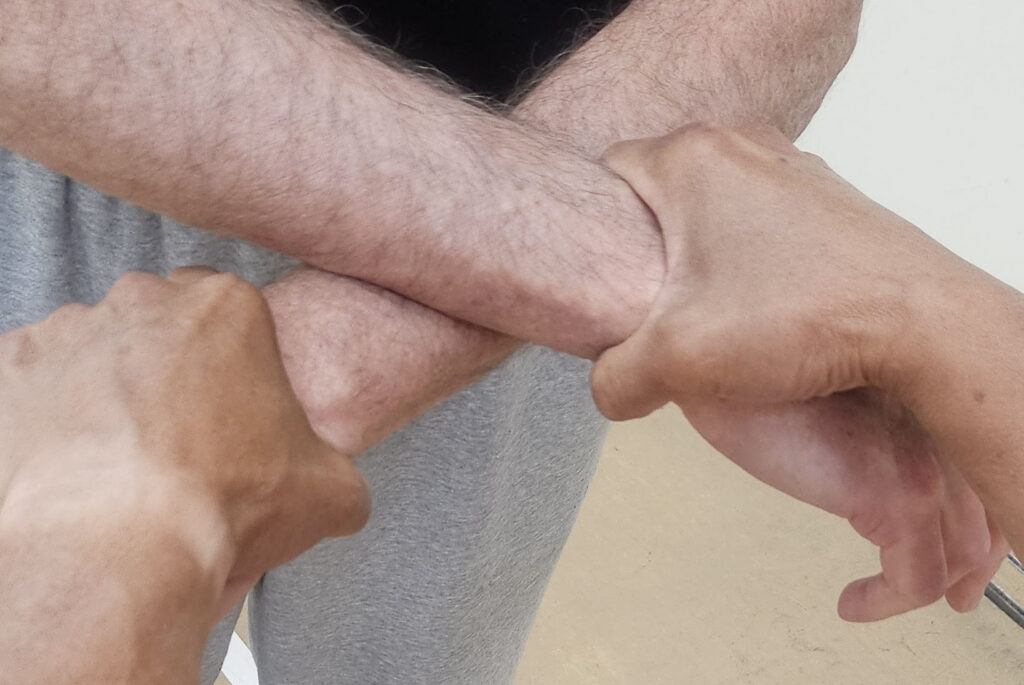
Two hands crossed over – low

You begin to understand why it’s so important to adapt a technique to the situation at hand. Blindly repeating a skill without considering context can actually get you into deeper trouble. In order to make effective adaptations, you must truly understand both the mechanics of the technique and the specific situation you’re facing. Only then can you choose the method that is most efficient and effective for you in that moment.

Necessity of Follow up

Despite our good intentions, there are rare moments when the aggressor simply won’t stop—and in those situations, you must inflict pain or damage to force them to cease their aggression. This is what I mean by follow-up.

When you complete a technique, you’re not pausing for a picture-perfect moment—you’re actively repositioning yourself to limit your opponent’s ability to continue the attack. If they keep resisting, you must be prepared to cause pain. This isn’t a game—it could be a matter of life and death. At that point, you cannot hesitate.

We introduced the 3/4 turn and demonstrated how it can be used as a follow-up after escaping a grip. It’s crucial to keep your opponent engaged throughout the movement. A common mistake is to reposition each body part sequentially without affecting your opponent—this gives them opportunities to recover or counter.

EXERCISES

3/4 Turn adhoc notes

  • When learning a new skill, it’s important to start by practicing on just one side.
  • I usually recommend starting with your dominant side, as it tends to make the learning process smoother. However, once you’ve learned both sides, shift your focus to the side you struggle with the most—this will help build confidence and improve overall ability.
  • Use a fixed reference point for your starting position and another for your end position. This helps avoid confusion, especially when learning turns, where it’s easy to lose track of how many degrees you’ve rotated.
  • For the 3/4 turn, your back foot must step past the front foot from behind to complete the turn in a balanced stance.
  • Throughout the turn, maintaining your balance is essential—you should not be wobbly or unstable at any point.
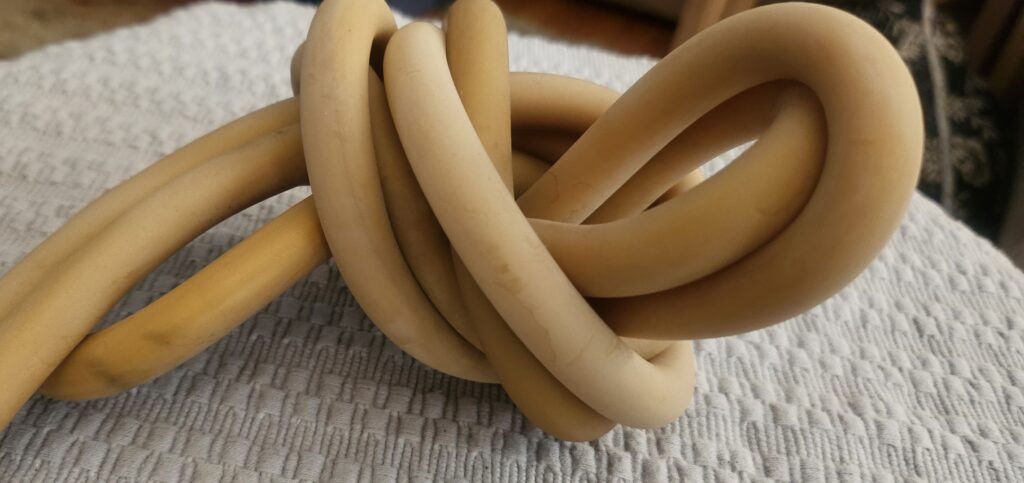
  • Use a rubber band to add resistance during practice—this helps train your body not to falter when encountering real-world resistance.

SSD – Class notes 2025-06-05

DISCUSSION

There are so many pieces to each move—how can we possibly remember them all?

Who says riding a bicycle is easy? Learning it when you’re young is much easier because you’re not overwhelmed by fear. As a kid, you’re eager to learn because it looks like fun. Plus, if your friends are doing it, you want to do it too. From riding a tricycle to transitioning to a two-wheeler, then to an electric unicycle—from being pushed on a bike to finally pedaling on your own, going uphill and downhill, and even experiencing your first fall—it’s all part of the journey of learning and growing. Learning is fun and exciting.

When it comes to your body, there’s no owner’s manual. There are no warranties, and absolutely no return policies. You must learn to use it in the best way possible. Many martial arts teachers present self-defense skills as absolutes—you’re supposed to trust and imitate without questioning or understanding how and why each technique works or fails. This approach does make teaching easier. However, blindly imitated skills may not be adaptable when the assumptions behind them change.

We aim to teach and explain the principles of each skill. Eventually you will see we’re applying the same core principles repeatedly. The number of principles is limited, but it takes time to learn and apply each one successfully. The good news is, once you’ve learned a principle, you can apply it again and again in many different situations. This will make it more useful in real life situations.

If I develop dementia later in life, will I lose everything I’ve learnt?

You need to invest enough time and repetition so that the movements become automatic and effortless. In a real encounter, there’s no time to think or analyze—you must react instinctively. That’s why training until a movement becomes a natural reflex is essential. When you reach that point, the skill becomes truly yours, and it will emerge automatically when needed.

Speed versus more muscles

Functional use of the muscles is essential—not only to create movement but also to maintain a standing position. However, a common mistake is shifting the focus from functional intent to simply contracting muscles. Indiscriminate muscle contraction often slows down movement.

Speed matters. The ability to deliver without telegraphing—i.e., without showing your intent through unnecessary preparation—gives you a natural head start. Reducing the distance also gives you an added advantage. We all understand that having more time to focus and prepare can generate more power. But more power is meaningless if it doesn’t arrive in time. In that case, it’s just wasted effort. The priority must be getting there first—not hitting harder.

Furthermore, if you target softer and more sensitive areas, even a relatively light strike can be more effective. For example, try slapping your palm against your thigh—it might sting a little, but it’s no big deal. However, apply that same force to your nose, and it will likely make your eyes water and cause you to flinch the next time something comes toward your face.

SCENARIOS

Two hands crossed over – low

If you think the two hands version is too complex to remember, do try the following approach:

  • reduce the level of complexity by taking away one hand and focus in on one arm.
  • so think through what you need to do if you have limited space to work with and which direction is the most vulnerable side of your opponent’s grip. Hint: It is always the direction of where the fingers are pointing. Or imagine what is being gripped is not your hand but a pole, the direction of the length of the pole should be the general direction of your counter.
  • If you attempt to move the arm in the direction you aimed at, you will find that it won’t do much because your opponent can neutralize your movement by simply moving along the same direction. To solve that. all you have to do is to use any part of your body to block him from moving with you. (e.g. use you hand to block, use his own hand to block, use any part of your body to block, reversal of direction of movement, etc.)
  • When the above step works, then find a way to create a solution that can work when both arms were gripped.

EXERCISE

Flicks

A typical whip-like motion may cause pain, but it usually lacks penetration power. For self-defense, we want our strikes to be destructive.

To achieve destructive impact, you need to generate maximum pressure. This means minimizing the contact area—so the force is concentrated. For that to happen, the strike must land perpendicularly to the surface of the target.

To make this possible, you must adjust the motion slightly so that the final few inches of the strike travel in a straight line toward the target.

A common mistake is to think that “leaning in” adds body weight to the strike and therefore causes more damage. Another myth is to tense up the muscles. Our experiments show otherwise. Staying loose and relaxed allows your body weight to flow naturally to the endpoint of the movement. Muscle tension actually disrupts this transmission—resulting in a strike powered only by muscle speed. “Leaning in” during the hit suffocates the hit instead of helping.

What we want instead is an end speed that accelerates exponentially, producing a much more explosive force. The key is relaxation, not forceful effort.

(Do review the notes from last week about how to avoid “whipping of the head”)

SSD – Class notes 2025-05-29

DISCUSSIONS

Warmups – what you need to cover?

For the purpose of self defense, warmups have two goals, either avoid injuries from falling or protect yourself from straining some muscles while trying to exert power. The other thing that you need in self defense is reflex and movement speed. Your mind and body need to be fully awake and alert.

Short Power – The ability to generate short, explosive power is of strategic importance in our system of self-defense. Since we cannot compete in terms of raw or absolute speed, we must rely on relative or smart speed. The first simplest way is to always find the shortest path possible. A large, swinging punch—like those seen in old John Wayne movies—will likely never land, whereas a short, explosive flick targeting sensitive areas of the body may be far more effective. The ability to use short, explosive power means that even if you miss, you can continue your attack or flow without needing to pull your punch back to strike again. Resetting requires covering more distance, which takes more time.

SCENARIOS

Cross-arms two handed grips – low

One way to determine which direction to escape is by looking at the direction the fingers are pointing. In this specific case, the grip—and therefore the fingers—is facing downward. Thus, the escape direction is also downward. Although this may seem like a difficult grip to break, all you need to do is use any part of your body to stop the grabbing arm from following the hand that is trying to escape. In class, two or three variations of this technique were demonstrated.

General principle of all of the escapes

Notice that there are multiple elements at work for each of the escape skills.

  • Direction of escape – Moving into the palm is usually the wrong direction. Instead, follow the opening or the direction the fingers are pointing.
  • Projection and leverage – You need to project force to create a rigid structure, allowing your arm to function like a crowbar.
  • Movement of body parts other than the part being held – Typically, you do not move the body part being gripped. Instead, you move another part of the body that has room to maneuver. This helps avoid direct, point-to-point resistance against the opponent’s force.
  • Amplification of movement through twists and bends – Twisting the wrist during the technique amplifies its effectiveness. A bent arm can also act like the “lip” of a crowbar, adding leverage without needing more space..

EXERCISES

Flicks

Sometimes I refer to it as a whip or a wave. The physics behind this movement rely on the conservation of momentum. With more weight at the end and less at the tip, this principle ensures that the tail always moves the fastest. Speed is a crucial factor when it comes to hits or impacts. A strong person can push or lift heavy objects, but it’s speed that causes pain on impact.

One common challenge is learning not to tense the muscles. Another key aspect is ensuring that the “whipping” motion propagates through the arms and hands—while also controlling the head to prevent it from being “whipped” along with the arms. The solution is to slightly tense the neck, allowing the force to travel cleanly through the arms without disrupting head control.