DISCUSSION
Weapon as an extension of the arm
I totally disagree with this generalization. Under this statement, it is easy to assume that a fight is just a fight – with or without weapon and that is a very dangerous thought. If you show up in front of the police and suddenly wave a plastic gun, it will not end good. If you assume that you can handle a knife like what is usually shown in public demos, that thought may kill you.
To understand the difference and its implications, a common steak knife is one sided and while it is sharp, it is needed to use the blade like a saw going back and forth and not intended to stab. Now, try imagine if I have a surgical knife in my hand, even an accidental touch on the tip or along the blade will get you bleeding immediately. If you bother to experiment, it can easily slice through even leather. So I ask you again, does fighting against someone carrying different type of knife matter?
Each weapon owns its own characteristics. You must appreciate the pros and cons of each to be able to defend against any.
We are starting this new season with the use of stick as a weapon potentially. So we are going through the different basic maneuvers to learn to appreciate what you can do with a stick. While this is serious business, I want you to enjoy the process of learning and ultimately, not to make “silly” mistakes.
Understanding circles
When you learned about circles back in high school, you were introduced to several key components:
- Center of the circle or sometimes we say pivot in context of a rotation
- Radius (or diameter = 2 × radius) — the closer you are to the center, the smaller the circle
- Circumference is the outer perimeter of the circle drawn
- Tangent — a line perpendicular to the radius at the point of contact (similar to where a wheel touches the ground)
A circle is a two-dimensional concept. If you rotate it around an axis, it forms a sphere—a three-dimensional object.
One additional concept to consider is motion. If the circle or sphere moves in any direction, its center is no longer fixed. We now have a moving circle or sphere.
In wrist release techniques, we begin by assuming the opponent is stationary – it makes it easier to learn. However, in real life events, you must adapt the technique to account for a moving center. We will get into those practices in this season as well.
Some inherent properties of circles:
- A straight line, represented by a tangent, touches the circle at a single point and then diverges away from it.
- If you draw two radii from the center, the farther you move from the center, the greater the distance between those lines becomes.
- A small “slice” of a circle (like a piece of pie) is simply a sector. It still follows the same geometric principles as a full circle.
These principles have direct applications in movement and combat:
- When someone swings a stick at you, the closer to the tip of the stick, the higher the speed—and therefore the greater the impact. This means you have two better options: move out of range or move all the way in. Staying in place and attempting to block while the hitting stick is at full extension is often the worst choice.
- Similarly, when someone throws a straight punch and you attempt to catch or control it, your chances improve the closer you are to his shoulder (the center of motion). If you try to intercept at the end of the strike, even a small movement at the shoulder translates into a large displacement at the hand, making control much more difficult.
SCENARIOS
Five single grip reviews
Again, we start with getting out from a single hand grip as the basic. The common mistakes still need more practices to get rid of.
While we learnt the basics, we need additional practices to get fluent with the extreme cases where you have not space or that your opponent is actively dragging you. To be able to adapt to different situations, the techniques have to be adaptable and flow naturally. That will take a lot of repetitions.
Wrist lock
- Remember the location of the pivot and the intent is to circle around the pivot
- Use body motion to amplify the amount of force you can deliver: one side goes down and the opposite side goes up.
- Understand how the wrist joint works, you are exploiting the natural limits of the wrist joint.
- Remember that every person is a unique individual. While the majority of people will tap quickly but there is a chance that you may encounter someone who is ultra flexible or someone who can tolerate sharp pain. So while it is important to understand your own body, this is NOT my go-to technique. I use it only when it naturally presents itself.
EXERCISES
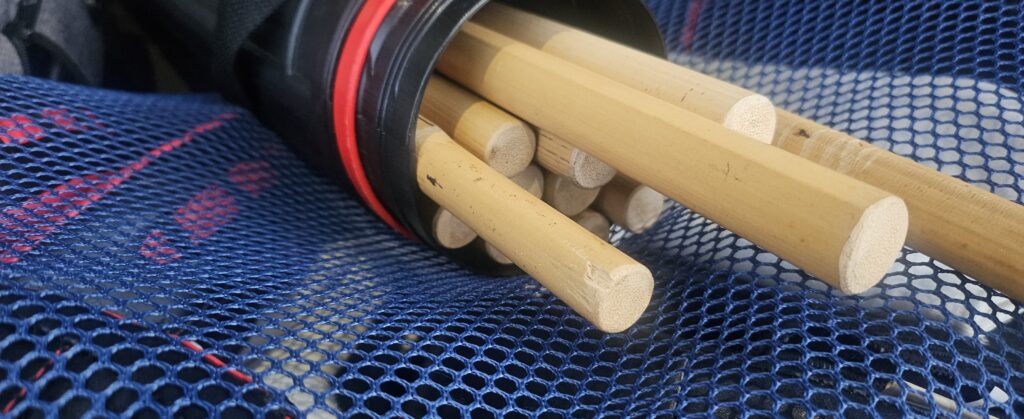
The sticks we use are approximately 28 inches long and made of rattan. They may look like bamboo (which is hollow), but rattan has a solid core and slight flexibility, making it more suitable for training. They are typically about 1 inch in diameter.
While there is a traditional “standard,” it is important to recognize that the appropriate size also depends on your grip and wrist strength. It is better to start with a lighter stick and gradually increase the weight over time. As always, focus on developing proper technique before adding power. Your arm strength will improve naturally with consistent training. The stick is a tool to help you develop speed, strength, endurance, and grip.
In class, I provide sticks for everyone. At home, you may use any stick of similar length and shape. However, do not use it to strike anything. Make sure there are no people or animals nearby and keep a safe distance from furniture—you could easily damage something if you are not careful.
Stick Grip and Basic Maneuvers
These exercises are designed to develop familiarity with the stick and improve control.
Developing Wrist and Elbow Flexibility
Practice swinging the stick:
- From high to low
- Low to high
- Side to side
- In a figure-eight pattern
Focus on maintaining control, smooth motion, and relaxed but intentional movement throughout.
SIDE NOTES
I decided to cover some weapon basics for this spring session for two reasons. First, I am adapting to the fact that two of the students have recently undergone hip surgery. It is important to learn how to defend yourself when you are in a physically compromised situation.
I also admire their determination and commitment. Learning to persevere and adapt despite challenges is the mindset I want all of you to develop in order to gain a mental edge in survival.
Second, I believe we have covered enough foundational concepts, and it is now time to strengthen our physical execution so we can effectively carry out what we know we should do.