DISCUSSION
Relax
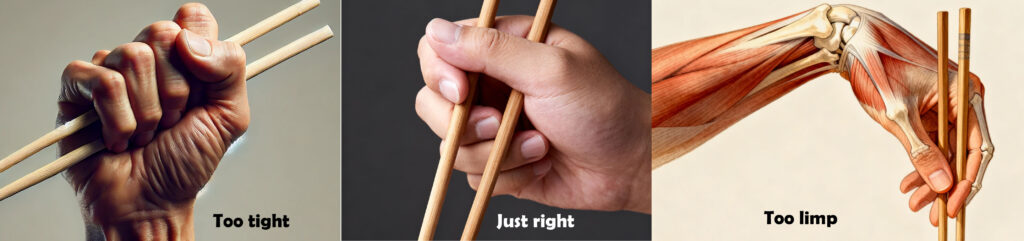
We often use the word “relax”, but here it has a specific, technical meaning. Take a look at the banner picture of the article: the “just right” state is neither tense (“fight mode”) nor limp. Neither extreme allows for effective handling.
The “just right” state is actually a range, and the only way to discover it and perfect it is through experimenting and practicing. You also need to understand the functional purpose of each movement and be adaptable to different types of food and chopsticks. As an example, when you pick up tofu with chopsticks, you can’t squeeze it like you would a piece of chicken — you must adjust your grip.
Key points to get out of wrist grabs without escalation
When we reviewed techniques for escaping wrist grabs, several key concepts were common across all of them:
- Project through the fingers
- Pivot point
- Relax physically and emotionally
- Flow with the force and find weakness.
To help you remember these, use the phrase “Please Practice Relax First.”
- P – Please: Project through the fingers. Extend your arm with focused intent, as if energy is flowing outward. This helps create a stable and functional lever.
- P – Practice: Pivot point. Keep your pivot point steady — it should not move or wiggle. It’s a key element in creating leverage.
- R – Relax: Relax physically and emotionally. This helps you think clearly and avoid wasting effort by trying to move your opponent’s entire arm. It also prevents triggering their defensive reaction — your body language and mindset matter.
- F – First: Flow with your opponent’s energy. For example, when your opponent grabs you, their fingers exert inward pressure. Instead of resisting outward, find ways to move inward without fighting it directly.
Weaknesses in the human grip
Fingers – We grab objects like groceries or tools by bending our fingers inward. To tighten our grip, we squeeze inward. If someone push my fingers inward, I am more likely to loose the grip.
Wrists – The wrist is strong on the palm side because it’s used frequently for lifting. The back of the hand, however, is much weaker since it rarely bears weight. While you can always train yourself stronger, but if you compare your own strength inward vs outward, you will find one direction is weaker.
Grip – When someone grabs your wrist, they aim to control you. If you remain relaxed, a single hand grip can only restrict you at the grip but not anywhere else — you can still move your fingers, smile, turn your head, or bend your knees. But if you tense up or panic, that grip will control your whole body.
Situational Awareness and Strategy
When we communicate, we express ideas and respond to the topic at hand — adapting our tone and wording depending on the situation or the person we’re speaking to. Sometimes we even use body language like a smile, a smirk, a wink, tension of the body, etc.
When it comes to fighting, a lot of people thought it is fundamentally different and expect to have standard solutions like the routine/form they practice everyday. When they are told “it depends…” and asked to understand the mechanics and concepts behind the technique, they think it is too complicated. But life is complex. Intelligent conversation — like martial adaptability — is difficult to both teach and learn.
Fighting is just another form of interaction, with higher stakes. Through martial arts, you’ll gradually understand not only yourself but also how others think and react.
SCENARIOS
High crossover wrist grab
Key Points
- Relax and turn the wrist slightly so the palm faces downward.
- Align your fingers with your opponent’s forearm.
- “Wipe” 90 degrees with the fingers leading the motion.
- Wrap and grab your opponent’s arm to steer them into a non-confrontational but strategic position.
Reviewed all the other grips learned so far
Through repetitions with different partners, you start to see the common thread that links all these together. You will also be able to remember the key-points that make it work instead of just imitating what may not be important.
Common Mistakes
- Tensing the arm, causing the whole arm to move and sometimes even ended up trying to lift your opponent’s entire body. You should instead attempt to affect only his wrist and fingers.
- Lifting the shoulder or elbow to “fight” the grab.
- Forgetting to follow through to the strategic position.
EXERCISES
We didn’t have time for exercises together, but I trust you’re motivated to train on your own. Continue with the exercises from previous classes — your leg muscles and core could always use more work. Or maybe a simple plank for a couple of minutes.