DISCUSSIONS
Warmups – what you need to cover?
For the purpose of self defense, warmups have two goals, either avoid injuries from falling or protect yourself from straining some muscles while trying to exert power. The other thing that you need in self defense is reflex and movement speed. Your mind and body need to be fully awake and alert.
Short Power – The ability to generate short, explosive power is of strategic importance in our system of self-defense. Since we cannot compete in terms of raw or absolute speed, we must rely on relative or smart speed. The first simplest way is to always find the shortest path possible. A large, swinging punch—like those seen in old John Wayne movies—will likely never land, whereas a short, explosive flick targeting sensitive areas of the body may be far more effective. The ability to use short, explosive power means that even if you miss, you can continue your attack or flow without needing to pull your punch back to strike again. Resetting requires covering more distance, which takes more time.
SCENARIOS
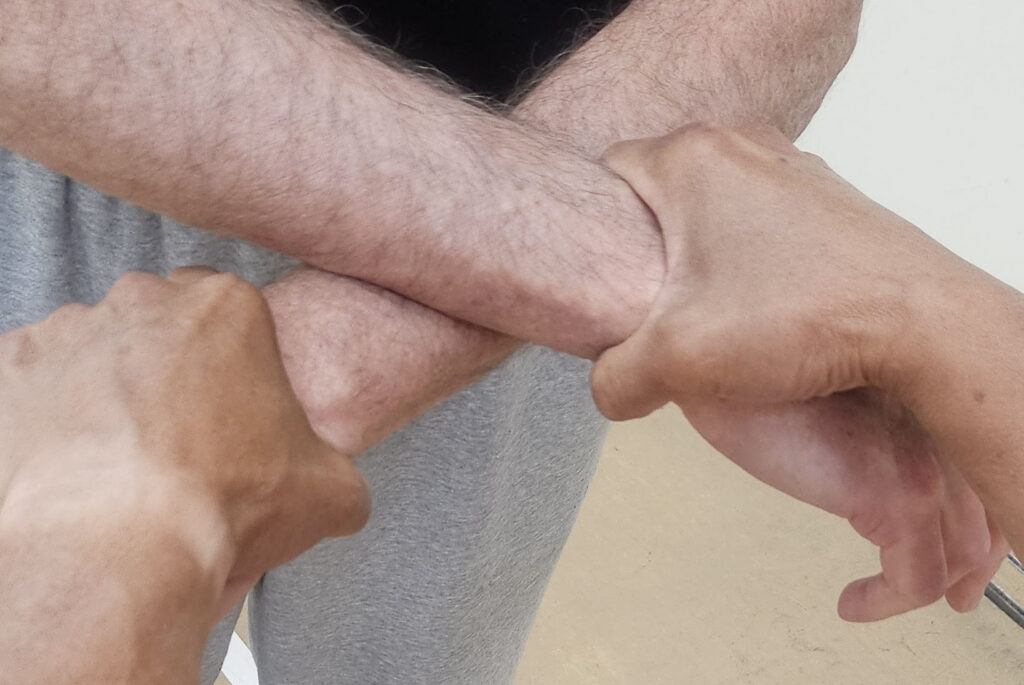
Cross-arms two handed grips – low
One way to determine which direction to escape is by looking at the direction the fingers are pointing. In this specific case, the grip—and therefore the fingers—is facing downward. Thus, the escape direction is also downward. Although this may seem like a difficult grip to break, all you need to do is use any part of your body to stop the grabbing arm from following the hand that is trying to escape. In class, two or three variations of this technique were demonstrated.
General principle of all of the escapes
Notice that there are multiple elements at work for each of the escape skills.
- Direction of escape – Moving into the palm is usually the wrong direction. Instead, follow the opening or the direction the fingers are pointing.
- Projection and leverage – You need to project force to create a rigid structure, allowing your arm to function like a crowbar.
- Movement of body parts other than the part being held – Typically, you do not move the body part being gripped. Instead, you move another part of the body that has room to maneuver. This helps avoid direct, point-to-point resistance against the opponent’s force.
- Amplification of movement through twists and bends – Twisting the wrist during the technique amplifies its effectiveness. A bent arm can also act like the “lip” of a crowbar, adding leverage without needing more space..
EXERCISES
Flicks
Sometimes I refer to it as a whip or a wave. The physics behind this movement rely on the conservation of momentum. With more weight at the end and less at the tip, this principle ensures that the tail always moves the fastest. Speed is a crucial factor when it comes to hits or impacts. A strong person can push or lift heavy objects, but it’s speed that causes pain on impact.
One common challenge is learning not to tense the muscles. Another key aspect is ensuring that the “whipping” motion propagates through the arms and hands—while also controlling the head to prevent it from being “whipped” along with the arms. The solution is to slightly tense the neck, allowing the force to travel cleanly through the arms without disrupting head control.