
DISCUSSION
Pushing Mechanics
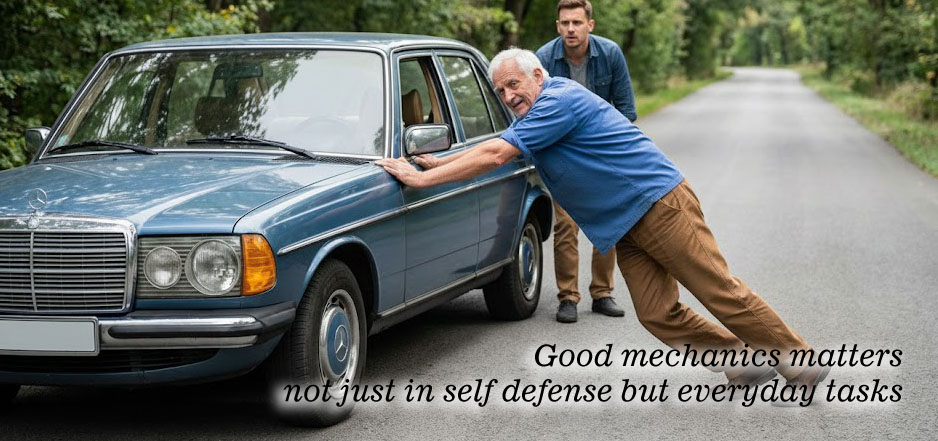
Leg position – the majority of people started the push with back leg straight. However, this may be good only if you are attempting in a defensive position where you feel you need to count on structure for support. However, if you want to generate enough pushing power to affect your opponent, straight leg takes away the possibility of pushing with leg muscles.
Legs should be bent at knee at about 90 degrees. The knee should not be facing the ground in almost a kneeing position. It should be facing between 30-45 degrees of the frontal line so that you foot can be placed comfortably.
Arm position – The elbows should be relaxed and pointing downward. Keep the shoulders relaxed and settled into your upper-body frame. Instead of actively trying to push with your arms, maintain this “relaxed shape” and imagine your body and arms as a single connected unit. The arms will transmit force naturally when the whole body moves.
Body position – It is tempting to lean your body into the push to add weight, but this creates several problems. If your opponent steps back while you are leaning in, you may lose balance and fall forward—unacceptable in a live exchange. Keep your torso relatively upright and relaxed (but not limp). You may round and sink the body slightly to help redirect force downward into your legs.
Avoid arching your lower back, as this often causes the abdominal muscles to tighten and makes your body rigid. A rigid structure becomes a lever your opponent can exploit. Instead, relax your back and lower back, allowing a gentle pelvic tilt so force from the ground to your legs and can pass smoothly through your body structure.
Placement of Center of Gravity
Physics tells us that if your center of gravity (CG) is positioned directly above the edge of your base of support, any movement beyond that point will cause the entire structure to collapse. While advanced practitioners may still maintain stability in such conditions, beginners should play it safe and keep their CG centered between both feet.
You can observe a similar principle in professional tennis: when waiting for a serve, players distribute their weight roughly 50/50 so they can move easily in either direction.
What is the best way to step forward?
We all hope there is just one type of stepping to master—wouldn’t that be nice? In reality, different situations call for different types of footwork. Here are a few examples that I will try to cover next class:
- Gallops – used to quickly cover distance when you don’t yet have contact with your opponent.
- Stutter steps – used to add body weight and momentum into your technique.
- Switch steps – used to change the leading foot and potentially adjust your angle, either to evade or to add power to kicks.
- Angling steps – to stay at same distance but at a different angle.
- Heel-toe – again an angling maneuver where you step without stepping
- Safe-your-bacon step – to be able to release your weighted leg. This is especially important for seniors to save yourself from tripping over uneven pavement, etc.
- Step-through – bringing the back foot past the front foot, similar to walking. This becomes challenging when you are already feeling resistance from your opponent or when you need to deliver a fast, long-distance strike with a changed lead.
…and many more.
SCENARIOS
- Try to push with different leg, arm and body positions and experience how it feels.
- Try tighten up your body using chest and apps
- Experiment with hands on partner’s shoulder versus hip
- Try to push against partners with different heights and body built as compared to you.
- Apply the knowledge about a strong stance versus a weak stance from previous classes.
EXERCISES
Practice push-the-wall – the wall will not move and so it is easy to detect if any part of your body leaks out the pushing force. Read the discussion on the top to focus in on what to focus on. Feel your body and see if you can deliver the same thrust without engaging your whole body.
Do try also the “extension” push where you extend your shoulder, chest and arms without moving your abs and lower body.
Plank – plank is a good exercise to strengthen your core. Do not allow your body to sag. You should have a slightly rounded back. Try to hold until you shake and then count eight more slow count.