
DISCUSSION
Last class until September
Today is the last class until September. The focus of today’s session was to teach some important exercises that will help establish a solid foundation for the new season.
During the session, we emphasized the efficiency of movement—generating maximum effect with minimal effort. However, this doesn’t mean training isn’t required. You still need to practice in order to program your nervous system so that responses become automatic.
You need muscles to carry groceries or help lift others. You need resistance training to see if you can maintain sustained pressure against an opponent. You need to bear weight to strengthen your bones, joints, ligaments, and more.
Summer is a great time to enjoy the sun—and also a great time to keep up with relevant training.
SCENARIOS
We did not have time to do scenarios. Do read all the notes available on this website.
EXERCISES
Consistency is key with all of these exercises. Try marking on your calendar the days you complete your workouts—it’s a form of positive reinforcement when you see your calendar filled with check marks.
The plank is a great exercise for training most of the muscles in your body to work together, helping you generate whole-body power. A common challenge for beginners is that when they execute a skill, they only copy the outlook of the move and forget about maintaining suitable tension for the rest of their body. Gaining control over your entire body is fundamental in all martial arts styles.
Here are some common mistakes to avoid when doing a plank:
- Core not engaged, causing the belly to sink or the lower back to arch.
- Hips raised too high, forming a triangle shape. Your body should form a relatively straight line from shoulders to heels.
- Shoulders behind the hands instead of stacked directly over them.
- Arms locked out, relying on skeletal support rather than muscular engagement. Keep a slight bend in the elbows to engage your triceps and better connect to pushing/punching mechanics.
- Elbows flared out instead of close to the body. In a guard position, elbows should protect the ribs. Keeping the elbows in also allows the shoulders to relax more naturally, improving endurance and form.
At first, holding the plank position can be challenging. The body weight pressing onto the wrists might feel uncomfortable—but this discomfort is necessary training if you want to develop the ability to deliver powerful palm strikes, such as into an opponent’s nose.
Leg Raise Exercise
Stand with your back flat against a wall. Keep your body upright and your support leg vertical. Slowly raise one leg in front of you while keeping it straight. When you reach your maximum height, pause—and then try to lift it just one more inch. You’ll feel your quads burn almost immediately. Once your leg starts to shake, begin counting to eight, then lower the leg in a controlled manner. Repeat with the other leg.
Key points to keep in mind:
- Your entire body must stay vertical against the wall. Avoid leaning back or tilting your torso to help lift the leg.
- Toes can point outward and stay relaxed—this isn’t a flexibility or stretching exercise.
- If your quads or hip flexors cramp up, perform the runner’s stretch, extending the cramping side behind you to release the tension.
Shift and slide
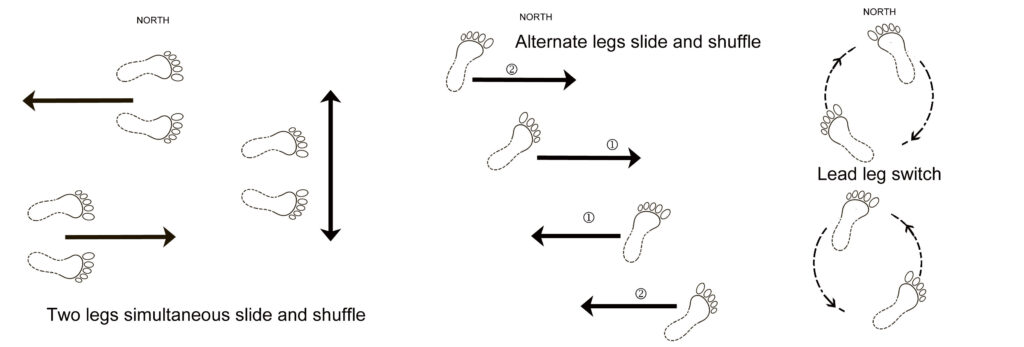
We did the prep moves which simply bend the knee and lift the heel up. We activate the calf muscles by bouncing on the ball of our foot and landing on the ball of our foot.
- With chest facing sideways (east) and head looking (north) over your shoulder, you shuffle both legs simultaneously backwards. Then you practice shuffling forward
- With the left leading leg, move your right leg sideways first, dragging your left leading leg sideways in the same direction. Remembering which leg goes first may be too hard to remember, simply think open wider and then drag to follow versus using the numbers as in the illustration..
- With a left front leading leg, use the hip to move the entire body around so that the right leg becomes the leading leg.
Common mistakes
- Simultaneous shuffle becomes a step-step two beat stepping.
- During the alternate leg slide, the front leg over stepped and the legs get all crossed up
- During the lead leg switch. only the foot moved, the body remains static. The chest should switch WITH the hip. The head remains facing North.
- You should not be jumping up and down, you should instead be sliding at the same level using mostly your calf muscles.
Prep for mobility
You may notice that the illustration above includes dotted lines in the heel area. This is to emphasize that the heel is slightly off the floor, with most of the weight resting on the ball of the foot. If you watch high-level sports like tennis, where quick movement is essential, you’ll see that almost every player moves on the balls of their feet. This positioning allows for faster and more agile movement.
If you’re learning to jump, start by practicing landings on the balls of your feet after a small hop.
To develop explosive power in your calves and feet, in addition to standard drills like calf raises, try hopping directly upward from a straight-legged position, pushing off using only your feet, calves, and toes. This exercise is excellent for developing quick, non-telegraphed movements. However, you have to land on the ball of your feet. If the landing still create a shock to your legs, you are allowed to add the landing with bent knees.